What Is a Decision-Making Tree and How Does It Work? | Lucid
What Is a Decision-Making Tree and How Does It Work?
7 min read
A decision-making tree is a branching diagram that connects a choice to possible events, later decisions, and final outcomes. It separates what you control from what remains uncertain. Use it to make competing paths comparable, identify missing evidence, and see where changing conditions could alter your next move.
Key Takeaways
1Separate choices from uncertain events. Launching a pilot is a choice, while customer demand is an uncertain outcome.
2Define the decision boundary before drawing branches. Specify the deadline, constraints, and outcome you want.
3Follow every branch to an actionable endpoint. “Demand is weak” needs a consequence, such as stopping investment.
4Treat probabilities and payoffs as assumptions to verify. A polished diagram cannot make weak evidence reliable.
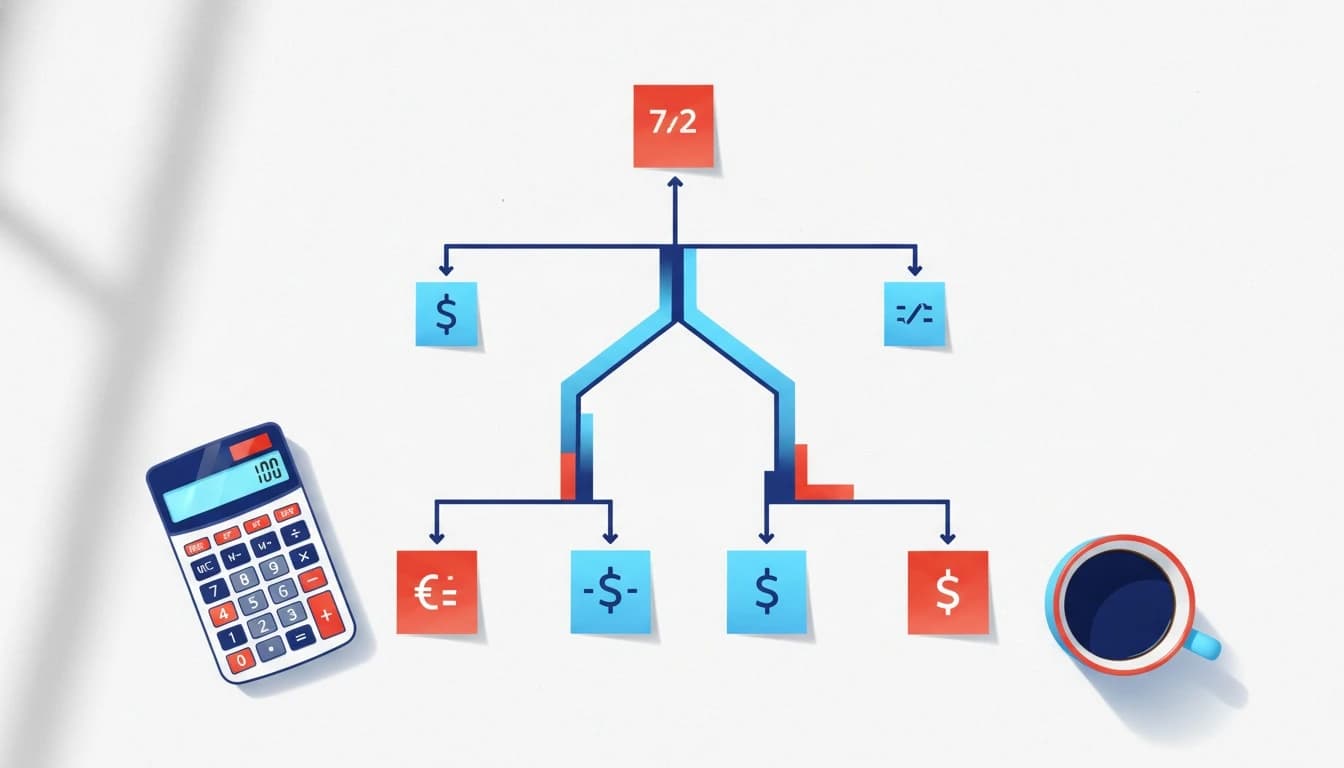
A decision-making tree contains nodes, which represent choices or events, and branches, which connect them. Read it from the initial decision toward possible outcomes. Each complete path should explain what happens if you choose an option and subsequent events unfold in a particular way.
Conventional decision-analysis notation distinguishes the elements below. Include a legend when your team uses different shapes, because diagramming tools do not always apply identical conventions.
Element
Common symbol
What it represents
SaaS market-entry example
Decision node
Square
A choice you can control
Run a pilot or defer entry
Chance node
Circle
An uncertain event
Pilot demand meets or misses the agreed target
Branch
Connecting line
An option or event outcome
Proceed with the pilot
Terminal node
Triangle or labeled endpoint
The consequence where analysis stops
Stop spending and retain the findings
The distinction between a decision and an event matters more than the shapes. You can choose whether to enter a market. You cannot choose whether buyers respond, although your actions may influence their response.
A general branching diagram can also classify information without representing a choice. Our explanation of tree diagrams versus decision trees clarifies that distinction when you are deciding what to draw.
When should you use a decision tree?
Use a decision tree when the order of choices and events changes what you should do. It is particularly useful when an initial commitment produces information that informs a later commitment. A pilot, for example, can reveal implementation problems before you approve a broader rollout.
Start by identifying the structure of your dilemma. Unstructured thoughts often mix alternatives, worries, and consequences in the same sentence. Separating those elements reveals whether you have a branching decision or simply several options to compare.
Situation
Suitable starting method
Reason
A pilot determines whether you expand later
Decision tree
Sequence and new evidence matter
Several vendors must meet the same requirements
Comparison table or decision matrix
You are comparing attributes rather than branching events
Market conditions could evolve in substantially different ways
Scenario planning
You need to explore plausible environments
Staff must follow a fixed approval procedure
Flowchart
The main task is executing a process
Set feasibility constraints before comparing attractive outcomes. A path that violates a legal requirement or exceeds an approved budget should not remain eligible because it promises stronger revenue. HM Treasury’s Green Book guidance on appraisal and evaluation similarly treats options appraisal as work that must address risk and uncertainty.
How do you make a useful decision tree?
Build a decision tree by defining the choice, identifying feasible alternatives, and adding only the events that could change the next action. Finish with consequences you can compare. We recommend starting without probabilities so you can check the logic before introducing numerical assumptions.
Consider a SaaS team deciding whether to run a market-entry pilot or defer entry. Assume the team can fund a bounded pilot, but broader expansion requires evidence of demand and manageable support work.
Write the decision as an action. Use “Run a market-entry pilot or defer entry?” Avoid broad labels such as “International strategy,” which provide no clear boundary.
Record the constraints. State that the pilot must use approved data handling and fit available support capacity. Remove any pilot design that cannot satisfy those requirements.
Draw the feasible alternatives. Add “Run pilot” and “Defer entry.” Give deferral a consequence too, such as preserving the budget while postponing direct evidence about demand.
Add the uncertainty that matters. Under the pilot branch, distinguish whether demand meets the agreed target and support stays within the capacity limit. Define both tests before the pilot starts.
Add the later decision. If the pilot passes both tests, the team can consider expansion. If it fails either test, the team must decide whether to revise the approach or stop.
Finish each path with a consequence. Record the spending commitment and operational effect. Then assign someone to verify each assumption before approval.
The resulting logic can be compact:
DECISION: Run a market-entry pilot or defer entry?

Defer entry
  -> Preserve the pilot budget
  -> Revisit when the missing market evidence becomes available

Run pilot within approved constraints
  -> Demand target met AND support within capacity
       -> DECISION: Expand within an approved plan, or stop
  -> Demand target missed OR support exceeds capacity
       -> DECISION: Revise and retest within remaining limits, or stop
This tree supports a specific conclusion: the pilot can justify gathering evidence, but it does not automatically authorize expansion. The later decision remains conditional on approval and operational feasibility.
For your own dilemma, follow the same sequence and replace the action labels. If you cannot write a concrete consequence at a branch endpoint, identify what information is missing before extending the diagram.
How do you compare the paths?
Compare complete paths using the same outcome measures and time horizon. Revenue from a full year cannot be compared fairly with implementation costs from only the launch period. Include the costs required to reach each endpoint, including spending on paths that ultimately stop.
Decision tree analysis evaluates the paths using their consequences and, where justified, probabilities or utilities. For the calculation itself, our worked example of expected value in a tree diagram shows how outcomes combine without treating the largest possible payoff as the best choice.
Keep evidence separate from judgment. Record whether a demand estimate comes from signed commitments, interviews, or an internal forecast. Those sources support different levels of confidence, even when someone assigns them the same probability.
When reliable probabilities are unavailable, use the tree to identify conditional actions and information needs. Do not manufacture precision. A useful next step may be checking procurement requirements or testing implementation effort rather than selecting a supposedly optimal branch.
What can make a decision tree misleading?
A decision tree becomes misleading when its structure hides relevant possibilities or its assumptions outlive the evidence. Detailed branches can make an analysis look complete even when it omits the outcome that would actually change your choice.
Watch for overlapping event labels. “Strong demand” and “High customer interest” may describe the same event, while neither accounts for customers who express interest but cannot obtain purchasing approval. Define outcomes so they are distinguishable and collectively cover the possibilities relevant to the decision.
Sequence also affects probability. Demand observed after changing pricing may differ from demand under the original offer. Estimates attached to later branches must reflect the conditions along that path.
Revisit affected branches when a constraint changes. If the pilot’s support owner becomes unavailable, its feasibility and consequences may change immediately. Date the assumptions and identify who can confirm them, rather than redrawing the entire diagram without checking the underlying evidence.
Keep the tree small enough to inspect. Combine branches only when they lead to equivalent decisions and consequences. Otherwise, simplification can erase the very distinction the team needs to evaluate.
Frequently Asked Questions
Can ChatGPT make a decision tree?
Yes. ChatGPT can draft a branching outline or diagram instructions from a written dilemma. Check every proposed option, dependency, and factual claim, and require evidence for probabilities rather than accepting generated estimates.
What is the difference between a decision tree and a flowchart?
A decision tree compares paths from a choice to possible consequences. A flowchart describes how a process proceeds, often including loops and repeated activities. Their symbols can overlap, so purpose is a better distinction than appearance.
Is a business decision tree the same as a machine learning decision tree?
No. A business decision tree models actions and consequences, while a machine learning tree learns splitting rules from data to predict a target. The scikit-learn decision tree documentation describes predictive trees used for classification and regression.
Do you need decision tree software to get started?
No. Paper or a shared document is enough to check a small tree’s logic. Consider software when maintaining branches, calculations, or shared revisions becomes difficult, and verify that its capabilities match those tasks.
For the market-entry pilot, verify the demand test and support limit before approving the first commitment. Then sign up for Lucid to turn written or recorded thoughts into an options map and compare the paths as those constraints change.