Tree Diagram Expected Value: Worked Example | Lucid
Tree Diagram Expected Value: Worked Example
11 min read
definition of analysis of variance is a way to quantify how much of the variation in outcomes is explained by different factors, and that same “what drives the spread?” instinct is exactly what you need when you build a tree diagram expected value model. This guide gives you a worked, reusable statistic tree diagram example, shows how to assign probabilities without hand-waving, attach payoffs and opportunity costs, compute EV across paths, and decide when risk tolerance should override the math.
How do you assign probabilities without guessing blindly?
A statistic tree diagram is only as good as its probabilities. The fix is not “be more accurate” (nobody is) but “be more defensible.” In practice, that means you anchor each probability to a base rate, then adjust with explicit conditional assumptions.
Start with the base rate. If you are modeling a product launch, don’t begin with “60% chance it works.” Begin with something you can point to: historical conversion rates, past launches, market benchmarks, or your own funnel data. For example, if your last three launches hit your revenue goal once, your initial base rate for “hits goal” is 33% until you justify a change.
Then make it conditional. Most decisions have a hidden dependency that should be a branch, not a footnote. Typical conditional branches we model for founders and operators:
“If the hire ramps in 30 days” vs “if it takes 90”
That is conditional probability: P(success) becomes P(success | shipped on time) and P(success | slipped). If you only model one top-line probability, you bury the real levers.
A quick sanity check I use in workshops is the “sum-to-one plus explanation” rule: every set of sibling branches must sum to 1.0, and you must be able to say, in one sentence each, what evidence would make you move that probability by 10 points. If you cannot, you are guessing.
If you want a rigorous refresher on variance and what “spread” really means, Wikipedia’s overview of analysis of variance (ANOVA) is a solid baseline. You do not need ANOVA to compute expected value, but thinking in factors and explained variation helps you choose better branches.
When teams get stuck on probabilities, we often step back and pick a tighter decision framework first. Lucid’s guide on how to choose a decision framework for your team is useful when the argument is really about process, not numbers.
How do you attach payoffs and costs to outcomes?
The most common EV mistake is not the probability math. It is the payoff definition. People model revenue and forget costs, time, and opportunity cost, then wonder why the “high EV” option feels wrong.
You want a payoff table that captures four things:
Direct payoff (revenue, savings, margin)
Direct costs (cash outlay, tooling, contractor hours)
Here’s a worked example you can reuse for a risky launch bet.
Worked payoff table: “Launch a new pricing tier in 30 days”
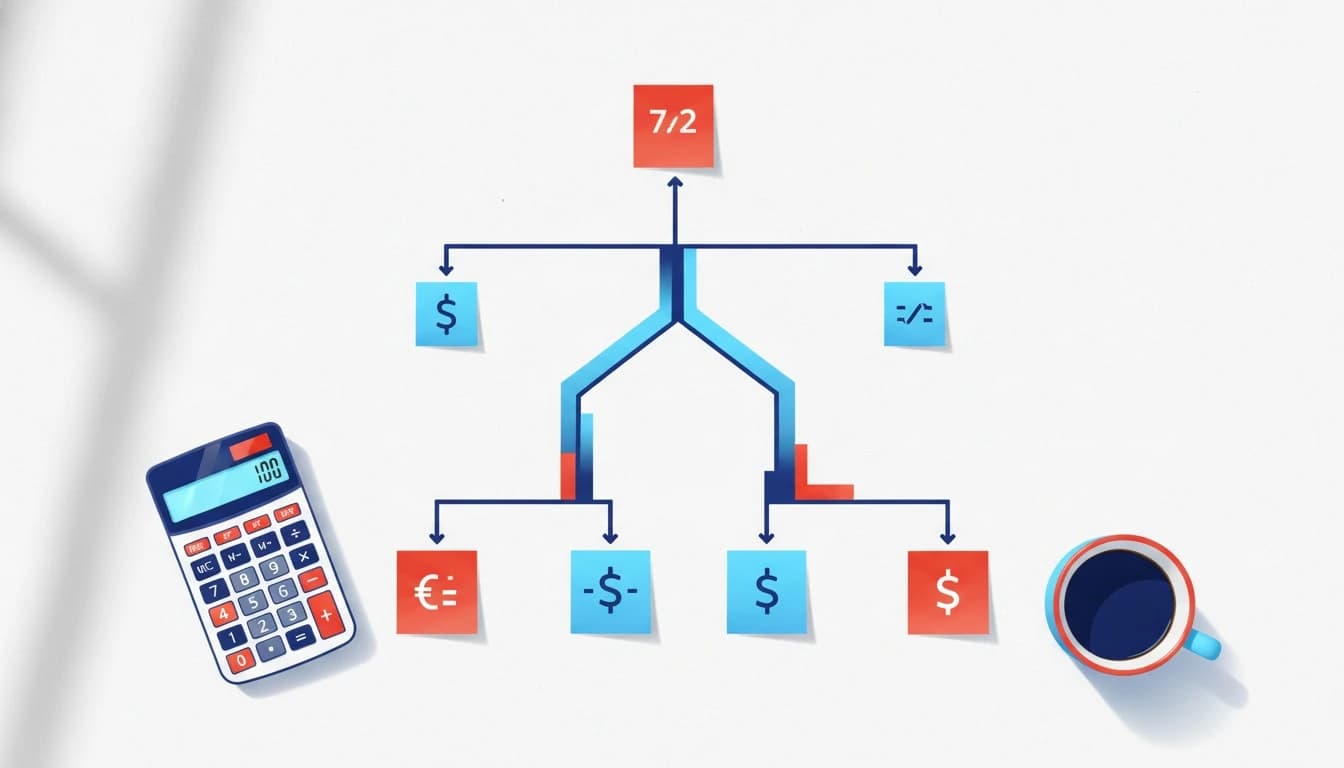
Assume you are considering a pricing experiment with two execution outcomes (on-time vs slip) and two market outcomes (adoption vs flat). This becomes a clean 2x2 tree.
Payoff assumptions (keep them simple and auditable):
If adoption happens, incremental gross profit is $180k over 12 months.
If flat, incremental gross profit is $20k (some upgrades, not many).
Build cost is $35k (engineering time valued internally).
If you slip, you lose $25k in opportunity cost (missed launch window + delayed pipeline).
If you ship on time, no extra opportunity cost beyond the build cost.
Path outcome
Incremental gross profit
Build cost
Slip opportunity cost
Net payoff
On-time + Adoption
180,000
35,000
0
145,000
On-time + Flat
20,000
35,000
0
-15,000
Slip + Adoption
180,000
35,000
25,000
120,000
Slip + Flat
20,000
35,000
25,000
-40,000
Two practical notes from real decision reviews:
I prefer gross profit over revenue for payoff because it prevents “growth at any cost” modeling errors.
Put time into the payoff assumptions, not spreadsheet formatting. A beautiful model with sloppy payoffs is a trap.
If you need a parallel tool for non-probabilistic comparisons (especially when stakeholders refuse to agree on probabilities), keep a decision matrix in your pocket. Lucid’s Decision Frameworks: the complete guide pairs well with EV because it gives you a structured fallback.
How do you compute expected value across paths?
Expected value is straightforward once the tree is correct: multiply each path’s net payoff by its path probability, then sum. The hard part is path probability, which is where conditional probability matters.
Let’s assign probabilities with explicit conditionals:
P(on-time) = 0.7
P(slip) = 0.3
P(adoption | on-time) = 0.4
P(flat | on-time) = 0.6
P(adoption | slip) = 0.25
P(flat | slip) = 0.75
Now compute path probabilities:
On-time + Adoption: 0.7 * 0.4 = 0.28
On-time + Flat: 0.7 * 0.6 = 0.42
Slip + Adoption: 0.3 * 0.25 = 0.075
Slip + Flat: 0.3 * 0.75 = 0.225
Then compute EV:
Path
Path probability
Net payoff
Probability-weighted value
On-time + Adoption
0.28
145,000
40,600
On-time + Flat
0.42
-15,000
-6,300
Slip + Adoption
0.075
120,000
9,000
Slip + Flat
0.225
-40,000
-9,000
Total EV
34,300
So the expected value of the pricing-tier bet is +$34.3k.
Two things you should do next, before you celebrate:
First, build variance intuition. EV hides the spread. This is where the “definition of analysis of variance” mindset helps: ask what factors drive the dispersion. In this tree, the negative outcomes are not catastrophic, but they are meaningful: there is a 64.5% chance (0.42 + 0.225) you lose money on the bet in year-one gross profit terms.
Second, run one sensitivity check. Pick the single assumption that “feels like the lie.” Usually it is adoption probability or build cost. Change it and see if the decision flips.
Here is a minimal sensitivity check table (one variable, two scenarios) that we use in scenario analysis reviews:
Assumption changed
Conservative case
Base case
Aggressive case
P(adoption | on-time)
0.25
0.40
0.55
Resulting EV
-2,050
34,300
70,650
If a 15-point move turns a “go” into a “no,” you do not have a decision. You have a research task.
For teams that prefer a visual board over a spreadsheet, this is also the moment to convert the math into decision logic you can debate. We often translate the tree into an options map and compare branches side-by-side in Grid or Table view, then keep updating it as assumptions change. That is the core workflow in Lucid’s decision board: input the dilemma, get structured options, then refine the consequences as you learn. If you are evaluating AI support for this, Lucid’s roundup of best conversational AI apps and real uses helps you pick the right tool for the job.
When should you ignore EV and use risk tolerance instead?
Expected value is not a moral truth. It is a long-run average. You should override EV when the distribution clashes with your constraints.
Here are four situations where I tell founders and analysts to stop arguing about EV and start talking about risk appetite:
1) You have a ruin scenario. If one branch takes you to zero (runway ends, key customer churn triggers a cascade, regulatory issue), EV becomes irrelevant. A 5% chance of ruin is often unacceptable even when EV is positive.
2) Your bankroll is small relative to the bet. Classic decision theory assumes you can repeat the bet many times. Early-stage companies cannot. If you cannot survive the downside, you do not get to “average out” into EV.
3) The payoffs are deeply asymmetric and time-bound. Hiring is a good example. A bad executive hire can cost 6-12 months of momentum. The opportunity cost is not linear, and the real loss is often strategic.
4) Stakeholders value stability over upside. For teams, this is where modifiable risk factors matter. You can often change the decision to change the distribution: smaller rollout, staged hiring, reversible experiments, kill-switch metrics.
A practical way to operationalize risk tolerance is to add a constraint line under your EV: “We will not take any option with more than X% chance of losing more than $Y” or “We require at least Z months runway in the worst case.” That turns a philosophical debate into a concrete decision flowchart.
If you want a quick comparison tool, use a decision matrix example next to the EV tree: EV for numeric outcomes, matrix for qualitative factors like brand risk, support load, and team morale. Treat SWOT analysis example outputs as inputs to the tree, not the decision itself. SWOT is good for surfacing factors; EV is good for committing to a choice.
Turn the tree into an options map so consequences stay real
A tree diagram is great for computing. It is weak for alignment. People forget what the numbers meant two weeks later, and the model goes stale the moment context changes.
The fix is to translate each top-level option into an options map with three layers: pros, cons, and future consequences. Then you can keep the tree math attached to the real-world implications.
Here is how we map the pricing-tier example into an options board:
Option
Pros (near-term)
Cons (near-term)
Future consequences (6-12 months)
Launch tier in 30 days
Clear EV upside, fast learning cycle, potential margin lift
Execution risk, support load spike, possible positioning confusion
If adoption hits, pricing architecture becomes a growth lever; if flat, you may need to simplify and rebuild trust
Delay and research
Higher confidence on adoption probability, cleaner rollout
Creates staged rollout muscle; can become default pattern for risky bets
This is where Lucid is useful: you can start from a messy voice note like “Should we change pricing or hire sales?” and get a structured options map with advantages, disadvantages, and future consequences, then compare in Grid/Table/Focus views. When you update one assumption (say, build cost or adoption), the board stays consistent instead of splintering into five spreadsheets.
If your decision is part of a larger launch motion, pairing EV trees with a repeatable workflow matters. The playbook style in AI content creation for SaaS product launches is a good example of how we keep cross-functional work coherent when stakes are high.
A reusable 10-minute checklist before you commit
Before you ship the EV number to a deck, run this quick check:
Do sibling probabilities sum to 1.0, and can you justify a 10-point move with evidence?
Does each payoff include costs, opportunity cost, and at least one second-order consequence?
Did you compute EV by path (not by averaging outcomes incorrectly)?
Did you run one sensitivity check on the most fragile assumption?
Did you apply a risk tolerance constraint that reflects your runway and downside capacity?
That checklist catches most EV failures I see in pricing decisions, hiring bets, and go-to-market launches.
Next step: build your tree, then pressure-test it in a board
Start by sketching a two-level tree on paper: one execution branch and one market branch. Fill in probabilities with base rates and conditionals, then build a payoff table that includes opportunity cost. Compute EV by path, run one sensitivity check, and write down your risk tolerance constraint.
If you want the decision to stay usable as context changes, turn the branches into an options map in Lucid and compare them side-by-side. Create your first board in minutes using the Lucid registration page, then keep updating the consequences as you learn. The goal is not a perfect model. The goal is a decision you can defend and revisit without starting over.