What Is Decision-Making Bias and Why Does It Persist?
Decision-making bias is a systematic pattern that distorts how people collect evidence, compare options, estimate uncertainty, or interpret results. The distortion can occur before a meeting begins. Whoever frames the question often determines which options appear legitimate, which risks receive attention, and what counts as success.
Cognitive bias in decision-making persists because operational environments reward speed, confidence, and alignment. Those qualities are useful until they suppress dissent or hide uncertainty. A product team under launch pressure may accept an aggressive adoption forecast because it supports the committed date; an operations leader may renew a weak vendor because switching costs feel more concrete than another year of service failures.
Bias also survives because teams usually inspect conclusions rather than the process that produced them. The Nobel Prize account of Daniel Kahneman's work on judgment under uncertainty explains how intuitive judgments can depart systematically from rational probability-based reasoning. In operational terms, a familiar story can feel more credible than a base rate, even when the base rate is better evidence.
A biased decision can still succeed. A disciplined decision can still fail. Outcome quality and decision quality must be reviewed separately, otherwise teams reward lucky guesses and punish well-reasoned choices that encountered genuinely unpredictable events. For a wider taxonomy, the decision bias types and operational examples explain how individual patterns appear in routine work.
Persistence usually comes from one of four process defects:
| Process defect | What happens | Operational symptom |
|---|
| Framing control | One person defines the problem and viable options | Every proposal resembles the sponsor's preferred path |
| Shared evidence | Estimates are discussed before being recorded | Forecasts rapidly converge around the first number |
| Social pressure | Rank, expertise, or urgency suppresses challenge | Objections appear only after approval |
| Weak memory | Assumptions and rejected options are not logged | Teams rewrite the rationale after results arrive |
The practical implication is direct: awareness training alone is weak protection. A team may know what confirmation bias means and still search only for evidence that supports its roadmap. Controls must change the sequence, visibility, or ownership of the work.
Which Biases Create the Greatest Operational Risk?
The most dangerous biases are those that combine distorted evidence with hard-to-reverse commitments. They affect roadmap scoring, risk acceptance, incident response, forecasts, and vendor reviews differently, so a generic bias checklist cannot provide the entire control design.
| Bias | Operational failure | Best first control |
|---|
| Anchoring | The initial estimate shapes later forecasts or vendor pricing expectations | Collect estimates independently before revealing any number |
| Confirmation bias | Teams seek supporting evidence and explain away contradictory signals | Assign an evidence owner to document disconfirming facts |
| Authority bias | A senior leader's preference is treated as proof | Require independent scoring before leadership discussion |
| Availability heuristic | A recent incident or visible customer complaint dominates probability estimates | Compare the event with historical frequency and exposure data |
| Groupthink | Agreement becomes more important than testing the proposal | Use a named challenger or separate red team |
| Escalation of commitment | Prior spending justifies further spending despite failed assumptions | Set exit triggers before funding or implementation |
Context determines priority. During incident management, authority bias and availability can cause a team to pursue the loudest hypothesis while quieter evidence goes untested. A good control is parallel hypothesis generation followed by explicit elimination criteria, recorded before the incident commander selects a path.
In roadmap scoring, anchoring often enters through effort estimates or an executive's proposed priority. Score independently, reveal estimates together, and investigate material gaps instead of averaging them away. Teams using a matrix should also examine common decision making matrix errors that distort rankings, especially overlapping criteria and weights chosen after seeing the result.
Risk acceptance has another failure mode: inconsistent scoring. One reviewer may interpret "high likelihood" as an event expected soon, while another uses it for any plausible event. Define each rating with observable examples, record residual risk after controls, and calibrate reviewers against the same cases. The likelihood and impact scoring method for risk controls provides a more detailed scoring structure.
Vendor reviews are particularly exposed to escalation of commitment. The team that selected the supplier may also assess renewal, making evidence of failure feel like criticism of its earlier judgment. Independent service review, predetermined exit conditions, and staged commitments turn a binary renewal into a form of real options analysis: continue, expand, reduce scope, or exit as evidence changes.
How Can Teams Control Decision-Making Bias With a Repeatable Process?

A repeatable debiasing process controls when options, estimates, objections, and assumptions become visible. The order matters. If a leader announces a preference before independent analysis, later scoring may merely formalize the anchor.
Use the following sequence for decisions with meaningful cost, risk, or reversibility:
- Write the decision statement. Name the choice, decision owner, deadline, constraints, and conditions that would make an option unacceptable.
- Generate options independently. Ask participants to propose paths before group discussion, including delay, staged commitment, and status quo where they are genuinely viable.
- Set criteria before scoring. Define what each criterion measures, how evidence will be judged, and which requirements are non-negotiable.
- Estimate privately. Collect forecasts, risk ratings, and confidence ranges before participants see one another's answers.
- Challenge the leading option. Run a pre-mortem, appoint a red team, and seek evidence that could reverse the current ranking.
- Record the decision. Preserve the chosen path, rejected alternatives, assumptions, dissent, owner, and review triggers.
- Review on evidence, not discomfort. Reopen the choice when a logged assumption fails, a constraint changes, or a predetermined trigger occurs.
Independent option generation is essential because a weak option set creates false precision. A carefully weighted comparison between three variations of the same proposal still excludes the real alternatives. Include structurally different paths such as phased delivery, outsourcing, scope reduction, or waiting for a dependency to mature.
A pre-mortem addresses optimism and group pressure by asking participants to assume the choice has failed and explain why. Gary Klein's Harvard Business Review guidance on performing a project pre-mortem describes the method as prospective hindsight, which makes concerns easier to raise before commitment.
Decision logs require discipline. Capture the evidence available at decision time, not a polished rationale written after the result. A usable entry contains the decision statement, options, criteria, key assumptions, uncertainty, dissenting views, chosen path, and explicit review conditions. That record is the control against outcome bias.
Scheduled reviews should focus on assumptions rather than reopening every argument. For example, a product investment may depend on integration effort staying within the approved capacity, a vendor meeting service obligations, and customer adoption reaching an agreed signal. If none of those assumptions changes, repeated debate adds noise. If one fails, refusing to review becomes escalation of commitment.
For high-stakes choices, pair the process with the team decision-making bias checklist. The checklist should function as a gate before approval, while the decision log preserves evidence for later review.
Decision tools help when they make options, criteria, evidence, uncertainty, and consequences visible to everyone involved. They fall short when users enter biased assumptions, manipulate weights, exclude inconvenient options, or treat a calculated result as authority.
Decision Making Matrix Controls Scoring, Not Judgment
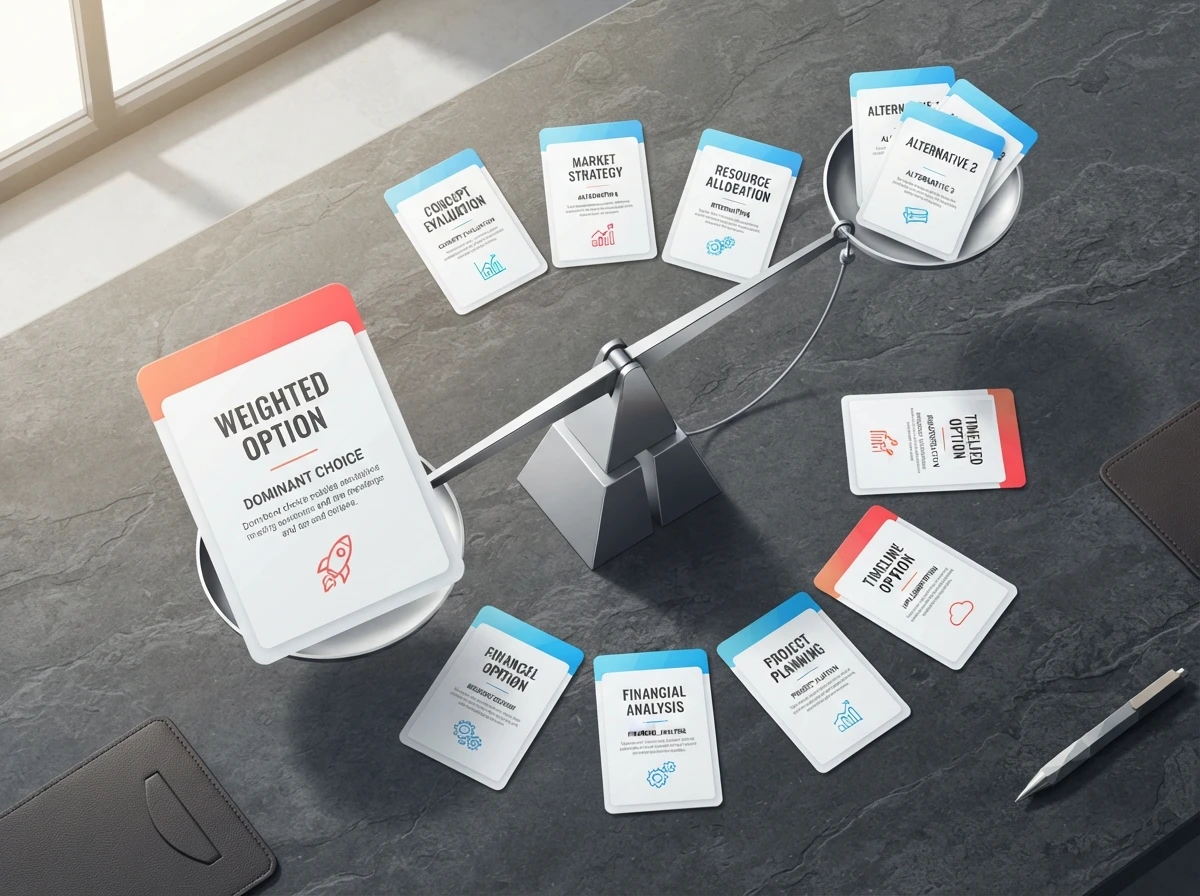
A decision making matrix compares options against explicit criteria, often with weights reflecting relative importance. It is useful for vendor selection, roadmap prioritization, and engineering choices where alternatives share measurable requirements.
The matrix becomes dangerous when precision exceeds evidence quality. A team can assign detailed scores to vague criteria such as "strategic fit" and produce a convincing total that nobody can defend. The control is to define scoring anchors before evaluation, cite evidence beside each score, and run sensitivity analysis to see whether modest changes reverse the ranking.
Use a matrix when criteria are reasonably stable and comparable. The weighted decision matrix setup process covers the mechanics; the bias control is independent scoring before reconciliation.
Scenario planning tools compare how options behave under different external conditions, while decision making tree software maps sequential choices, probabilities, and consequences. Both are more appropriate than a static matrix when uncertainty changes the path itself.
A tree can show that a low-cost pilot preserves the option to stop, expand, or change suppliers after new evidence arrives. Scenario analysis can expose an option that ranks well under the base forecast but fails under a capacity shortage or regulatory delay. Neither method repairs invented probabilities. Confidence ranges, source notes, and alternative scenarios must remain visible.
What Is a Decision Support System in This Context?
A decision support system combines data, models, and an interface to help people compare choices. It supports judgment rather than replacing accountability. The Encyclopaedia Britannica definition of decision support systems describes systems that assist management decisions by using information and analytical models.
Collaborative decision-making software adds shared option capture, comments, scoring, version history, and review workflows. These features reduce hidden reasoning and make changed constraints easier to trace. They can also amplify groupthink if early scores, senior comments, or popularity signals are visible before independent input.
| Tool | Best use | Bias control it supports | Main limitation |
|---|
| Decision matrix | Stable criteria across comparable options | Explicit criteria and independent scoring | Biased weights can predetermine the winner |
| Decision tree | Sequential choices with uncertain events | Consequence mapping and probability visibility | False confidence in weak probability estimates |
| Scenario planning | External uncertainty and changing constraints | Tests options outside the base forecast | Teams may omit uncomfortable scenarios |
| Collaborative decision board | Distributed evidence and team review | Traceability, dissent capture, version history | Social influence can spread faster |
| Decision log | Accountability and later review | Controls hindsight and outcome bias | Becomes useless when written after the fact |
Lucid converts written or recorded dilemmas into option maps with advantages, disadvantages, and future consequences, then refines each path when context or constraints change. Grid, Table, and Focus views support different comparison styles. That structure is useful, but the decision owner still needs to verify evidence, invite dissent, and own the final call.
When evaluating collaborative decision-making software, prioritize independent input modes, visible assumptions, change history, consequence mapping, and exportable records. A polished interface matters less than whether the tool preserves disagreement and shows why a recommendation changed.
Frequently Asked Questions
Can you give an example of a biased decision?
A product leader proposes a feature, shares an optimistic revenue estimate, and asks the team to score it against other work. The first estimate anchors later judgments, authority discourages challenge, and confirmation bias favors supporting customer comments.
What are the most common cognitive biases in team decisions?
Anchoring, confirmation bias, authority bias, availability, groupthink, optimism bias, loss aversion, framing, escalation of commitment, and outcome bias appear frequently in operational choices. Their importance varies by context, so teams should focus on the patterns that can distort expensive or hard-to-reverse commitments.
What are the big three biases to control first?
For most team decisions, start with anchoring, confirmation bias, and authority bias because they distort initial estimates, evidence collection, and willingness to disagree. Independent estimates, disconfirming evidence, and private scoring before leadership discussion provide practical protection.
Can decision-making software eliminate bias?
No. Software can standardize criteria, preserve assumptions, compare consequences, and expose scoring differences, but it still processes the options and evidence supplied by people. Independent input and accountable review remain necessary.
How should a team measure whether debiasing controls work?
Audit whether assumptions were recorded before approval, estimates were collected independently, dissent was preserved, and review triggers were followed. Over time, compare forecast ranges with actual outcomes and examine whether failed assumptions led to timely reconsideration.
Better decisions come from controlled process, visible evidence, and a willingness to revise when assumptions fail. For a structured place to map options, compare tradeoffs, and update consequences as constraints change, register for Lucid and apply the process to a live decision your team already needs to make.