Decision Bias: Types, Examples, and How to Avoid It
12 min read
Decision bias is a systematic distortion that pushes a choice away from a balanced assessment of evidence, tradeoffs, and likely consequences. It affects individuals and groups, especially under pressure or uncertainty. This guide explains the main bias types, shows how they appear in operational decisions, and provides practical controls for recognizing and reducing them.
Key Takeaways
1Separate criteria, evidence, and option scoring before discussing preferences. This prevents an early favorite from shaping the entire analysis.
2Record assumptions and disconfirming evidence alongside each option. A score without an evidence trail is difficult to challenge or update.
3Use independent judgments before group discussion, then test whether the preferred option survives changed weights, constraints, and failure scenarios.
What is decision bias, and why does it happen?
Decision bias is a predictable pattern of judgment error. Unlike a random mistake, it repeatedly favors certain information, interpretations, or choices. The describes it as a systematic tendency that affects how people process and interpret information.
A product leader who consistently gives more weight to recent customer complaints than long-term usage data is showing a pattern. A one-off spreadsheet error is different. The first changes what evidence feels important; the second is a calculation problem.
Bias happens because human attention and working memory are limited. People use mental shortcuts to reach workable answers without examining every possible consequence. The Stanford Encyclopedia of Philosophy discussion of bounded rationality explains why real decision-makers operate under constraints such as incomplete information, limited time, and limited cognitive capacity.
Pressure makes those shortcuts more influential. So do unclear objectives, ambiguous scoring criteria, personal ownership of an option, and incentives tied to a particular outcome. When a team has already spent months building a feature, for example, evidence against launching it threatens both the project and the status of its sponsors.
Decision-making bias also enters through process design. If the loudest stakeholder presents first, if risk definitions change between options, or if only supporting evidence reaches the approval meeting, the process itself creates a directional pull.
What are the most common types of decision bias?
The most common types affect how people search for evidence, estimate probability, interpret losses, and respond to social pressure. These categories can overlap. An executive may anchor on an early forecast, seek confirming data, and then defend the original plan because abandoning it would make prior spending feel wasted.
Bias
What it does
Operational example
Practical safeguard
Confirmation bias
Favors evidence supporting an existing belief
A product team interviews enthusiastic users while discounting churn interviews
Assign someone to build the strongest evidence-based case against the preferred option
Anchoring
Gives excessive influence to the first figure or proposal
A vendor's opening price defines the negotiation range before internal cost estimates exist
Produce an independent estimate before viewing external quotes
Availability bias
Treats vivid or recent events as more probable
One public outage causes every infrastructure risk to be rated critical
Compare the incident with base rates and the full event history
Framing effect
Changes preferences according to how the same outcome is presented
Leaders approve a migration described as preserving most customers but reject the same forecast framed around customer losses
Present gains, losses, absolute values, and uncertainty together
Sunk-cost bias
Protects prior investment even when future value is weak
A team funds another release because it has already spent heavily on the product
Judge incremental cost against incremental future benefit
Overconfidence
Understates uncertainty or overstates forecasting skill
A launch plan uses a single completion date despite unresolved dependencies
Require ranges, assumptions, and explicit confidence levels
Status quo bias
Favors the current state because change feels riskier
A company renews an unsuitable platform without comparing migration costs against renewal risks
Include “keep current approach” as a scored option with full future consequences
Groupthink
Suppresses dissent to preserve agreement or authority
Reviewers approve a senior sponsor's proposal without independently recording concerns
Collect initial judgments privately and invite objections before seeking agreement
What does decision bias look like in real situations?
Decision bias usually appears as a defensible-looking process with distorted inputs. The meeting still has a deck. The spreadsheet still produces a total. The distortion sits inside the evidence selected, the assumptions left unstated, or the criteria adjusted after someone sees an inconvenient result.
Consider a SaaS team choosing an incident-management platform. A recent outage makes advanced alerting feel decisive, so availability bias pushes every other requirement down the list. The incumbent vendor's renewal quote becomes an anchor. Procurement then frames migration only as a near-term cost, while the operational cost of staying remains scattered across separate budgets.
Hiring decisions produce a similar pattern. A strong first answer can anchor the interview, causing later responses to receive a generous interpretation. If interviewers discuss the candidate before submitting their own assessments, confirmation bias spreads through the panel. A structured process should use defined evidence standards and independent scoring, as shown in this decision matrix template for hiring decisions.
Roadmap reviews often expose sunk-cost bias. Teams argue that a weak initiative is “almost complete” without calculating the remaining engineering effort, opportunity cost, support burden, and expected adoption. The correct comparison begins from the current date: what future value will each additional unit of effort buy?
Risk work has another failure mode. A dramatic incident receives a severe score while common control failures stay underrated because they produce less memorable stories. Consistent likelihood definitions and documented evidence matter more than colorful heat maps.
How can bias affect individual and group decisions?
Individual bias distorts a person's judgment; group bias also changes what information reaches the decision. A person may misread probability through overconfidence or availability. A group can amplify that error through hierarchy, social conformity, selective disclosure, and pressure to close the discussion.
Groupthink is particularly dangerous when apparent consensus becomes evidence of correctness. The absence of objections may mean that participants agree, but it can also mean junior reviewers expect a challenge to carry career or relationship costs. The National Library of Medicine overview of groupthink describes how cohesion and the desire for unanimity can impair critical evaluation.
Consensus methods need visible dissent channels. Ask participants to record a recommendation and confidence level before discussion. During the meeting, examine material differences between judgments rather than averaging them away. The disagreement often reveals different assumptions about adoption, implementation time, reversibility, or risk exposure.
Decision ownership also matters. One accountable owner can prevent endless negotiation, but unilateral authority needs evidence controls when consequences cross several functions. The distinction between useful authority and unchecked judgment is explored in this guide to reducing risk in unilateral decisions.
How can you recognize decision bias before choosing?
Recognizing bias requires observable tests. Asking people to “be objective” rarely changes behavior because most participants can identify bias in others more easily than in themselves.
Use this sequence before approval:
Write the decision statement. Name the choice, deadline, decision owner, constraints, and outcome being optimized. Ambiguous questions allow participants to defend different objectives without realizing it.
Record the current favorite privately. Early preferences should be visible to the decision owner, along with the evidence that could reverse them.
Separate facts from assumptions. Label verified data, estimates, forecasts, and stakeholder opinions. A confident forecast remains a forecast.
Run a reversal test. Ask what evidence would make the rejected option preferable, then check whether that evidence was sought with equal effort.
Certain phrases signal that a bias check is overdue. “We have already invested too much to stop” points toward sunk-cost reasoning. “Nobody objected” may conceal groupthink. “This has never happened to us” ignores changing exposure, while “everyone is asking for it” often rests on a vivid but unrepresentative sample.
A decision journal makes these signals easier to audit. Capture the available options, assumptions, expected consequences, confidence, dissent, and review date. Teams that need a repeatable prompt set can adapt this decision-making bias checklist for team reviews.
Which practical techniques reduce decision bias?
Effective debiasing changes the structure of the decision. Training can improve vocabulary, but controls determine when evidence is collected, who sees it, and how disagreement is handled.
Technique
Biases addressed
How to apply it
Independent first judgment
Anchoring, groupthink
Collect estimates and recommendations before revealing senior opinions or group averages
Disconfirming evidence requirement
Confirmation bias, overconfidence
Define what would invalidate each option and assign someone to find it
Reference-class comparison
Availability, overconfidence
Compare the forecast with similar past projects rather than relying only on an inside view
Pre-mortem
Overconfidence, status quo bias
Assume the choice failed and identify plausible causes before approval
Reframing
Framing effect
Show the same outcome as gains, losses, absolute impact, and opportunity cost
Stop rule
Sunk-cost bias
Set cancellation or review conditions before additional investment is requested
Constraint change test
Anchoring, status quo bias
Change a key assumption and check whether the ranking still holds
Red-team review
Confirmation bias, groupthink
Give a reviewer permission and time to challenge evidence, assumptions, and omitted options
Psychologist Gary Klein's project pre-mortem method is useful because it makes dissent operational: participants imagine failure has occurred, then work backward to plausible causes. Run it before commitment, while the team can still change the scope or select another path.
Reference classes deserve more attention in SaaS planning. If an implementation estimate depends on “this migration being different,” compare it with previous migrations involving similar data volume, integrations, approval gates, and staffing. The relevant comparison should match the work, not the outcome stakeholders want.
Can a decision-making matrix limit decision bias?
A decision making matrix can limit decision bias by requiring consistent criteria, weights, evidence, and scoring across options. It works best when the team defines those elements before seeing which option wins.
A matrix is useful for vendor selection, hiring, architecture choices, control prioritization, and other decisions with several competing criteria. An engineering decision matrix might compare reliability, implementation effort, maintainability, and reversibility. An Excel decision matrix template can perform the arithmetic, but the spreadsheet cannot tell whether the criteria are biased or the scores lack evidence.
The setup order matters. Define the objective first, then constraints, criteria, scoring anchors, evidence requirements, and weights. Score options independently before discussing large differences. Finally, run sensitivity analysis by changing uncertain weights or assumptions. If a small adjustment reverses the result, the decision is fragile and should be presented that way.
Common matrix failures include double-counting similar criteria, changing weights after totals appear, and using false precision for weak evidence. This guide to common decision-making matrix mistakes explains how those errors can manufacture support for an existing preference.
A matrix also has boundaries. When options unfold through sequential events, uncertain probabilities, or contingent choices, decision making tree software may fit better. Real options analysis is useful when delaying, expanding, or abandoning a choice has measurable value. Both are forms of decision support systems, but neither removes the need to test assumptions.
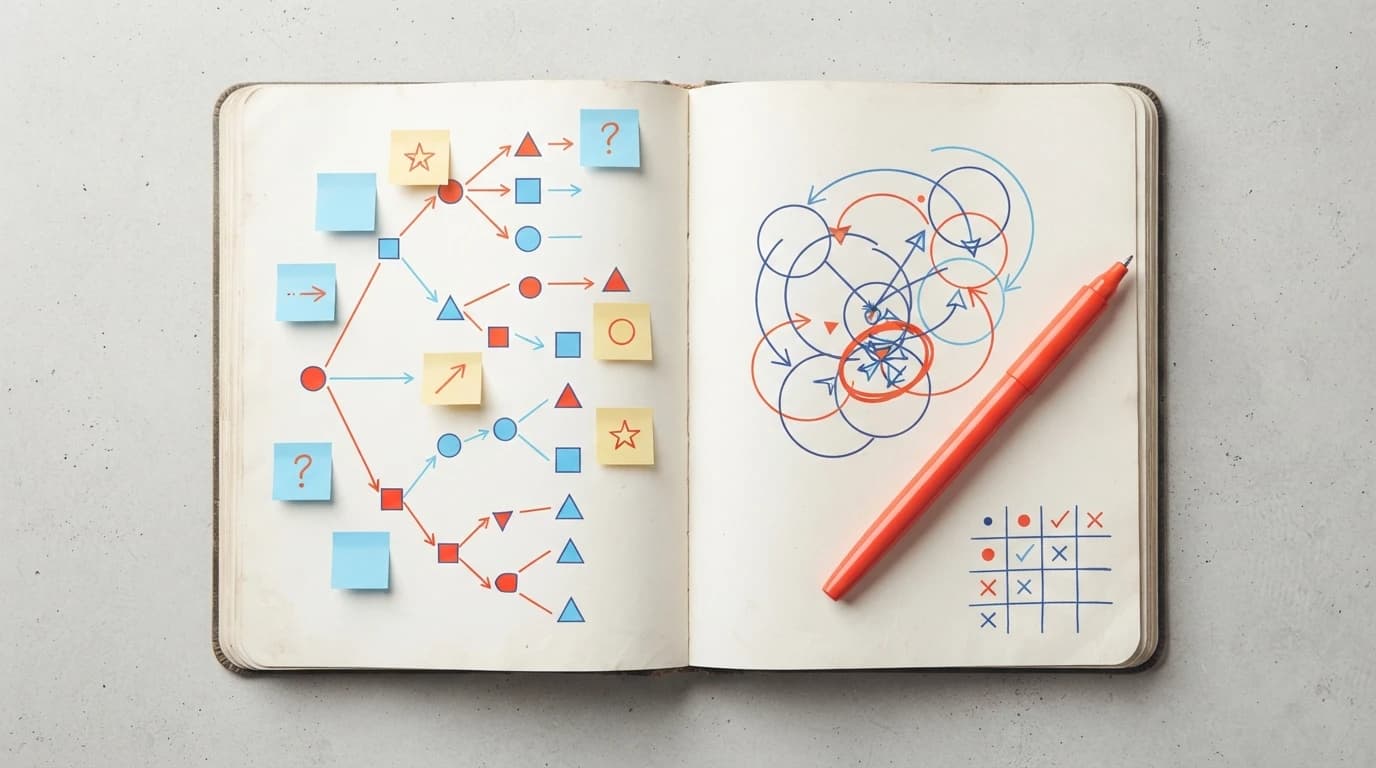
Lucid converts an unstructured dilemma into an options map with advantages, disadvantages, and future consequences, then updates the paths when context or constraints change. That structure is useful when a fixed matrix would hide how one changed condition affects several options.
What are the limitations of debiasing, and how can teams improve the process?
Debiasing methods reduce exposure to predictable errors, but they cannot guarantee an unbiased answer. Every technique relies on inputs chosen by people, and those inputs can reflect incomplete evidence, political incentives, poor definitions, or deliberate manipulation.
A red team may become performative if its objections carry no decision rights. Anonymous scoring can reduce hierarchy effects while concealing differences in expertise. A weighted model may appear rigorous even though stakeholders selected criteria to favor the incumbent. More process can also delay a reversible decision whose cost of waiting exceeds the likely value of further analysis.
Teams need controls proportionate to the choice. A high-consequence, hard-to-reverse commitment warrants documented assumptions, independent challenge, scenario analysis, and a named review point. A low-cost experiment may need only a clear hypothesis, spending limit, and stop condition.
A maintainable team process should specify who owns the decision, who supplies evidence, who challenges assumptions, and who must be consulted because they carry the consequences. Store the rationale beside the result. When a constraint changes, update every affected option rather than editing only the preferred path.
The final approval record should show the decision date, options considered, governing criteria, material uncertainty, unresolved dissent, and conditions that trigger review. This creates a defensible comparison without turning every choice into a governance project. For software-supported reviews, evaluate whether collaborative decision-making software preserves evidence and dissent instead of merely collecting votes.
Frequently Asked Questions
Can you give an example of a biased decision?
A team renews an unsuitable vendor because migration feels disruptive and previous implementation spending would be “wasted.” Status quo bias and sunk-cost bias are shaping the choice instead of future cost, risk, and value.
What are the most common cognitive biases in decision-making?
Common examples include confirmation bias, anchoring, availability bias, framing, sunk-cost bias, overconfidence, status quo bias, and groupthink. There is no single universally accepted list because taxonomies group related effects differently.
Is groupthink the same as confirmation bias?
No. Confirmation bias concerns how evidence is selected and interpreted, while groupthink concerns social pressure that discourages dissent and critical evaluation. They often reinforce each other in team decisions.
Can decision bias be eliminated completely?
No process can remove every bias because evidence, criteria, and forecasts still require human judgment. Independent input, explicit assumptions, structured comparison, and scheduled review can make distortions easier to detect and correct.
A sound decision process makes preferences visible, applies the same evidence standards to every option, and records what would justify changing course. To turn a complex dilemma into comparable paths and test how changing constraints affect the result, register for Lucid and structure your next decision before commitment hardens into momentum.