system analysis is the fastest way I know to turn a messy “we have three good options” debate into a result you can defend. A weighted decision matrix does that by forcing clear criteria, explicit weights, and consistent scoring. This walkthrough shows how to set decision criteria weights, normalize scores, build a scoring rubric, and rank options without gaming the numbers.
Why a weighted decision matrix is the most useful decision making matrix
A weighted decision matrix is a decision making matrix that compares options against criteria, then multiplies each score by an importance weight to produce a total. It is a practical form of (MCDA) used in product roadmaps, vendor selection, hiring, prioritization, and operations.
I’ve watched teams waste weeks because they never agreed on what “best” meant. The matrix fixes that by making your decision logic visible. If someone disagrees with the outcome, they can challenge a weight or a score instead of derailing the whole conversation.
One rule: a matrix is only as honest as its inputs. If you want a citation-grade definition for MCDA, Wikipedia’s overview is a solid baseline: multiple-criteria decision analysis (MCDA).
system analysis Step 1: Define options and lock decision scope
system analysis starts by defining what is in bounds, because scope creep is the easiest way to “accidentally” make a favorite option win.
Write down 3 things in plain language:
The decision statement (one sentence).
The options you are comparing (keep it to 3-7).
The time horizon (what “success” means in 3 months vs 2 years is different).
Example: “Choose a customer support platform for the next 24 months.” Options: A, B, C. Time horizon: 24 months. Budget cap: $30k/year. If an option violates a hard constraint, it is disqualified, not scored.
This is also where you decide the types of decisions making you’re doing: unilateral decision making (one owner decides) vs consensus decision making (group alignment). In practice, I recommend “consultative”: one accountable decider, structured input from stakeholders, and a transparent matrix.
decision making matrix Step 2: Create criteria that don’t overlap
decision making matrix criteria should be independent. If two criteria measure the same thing, you are double-counting.
Good criteria are specific and observable. “Ease of use” is vague. “Average time to train a new agent to proficiency (hours)” is scoreable.
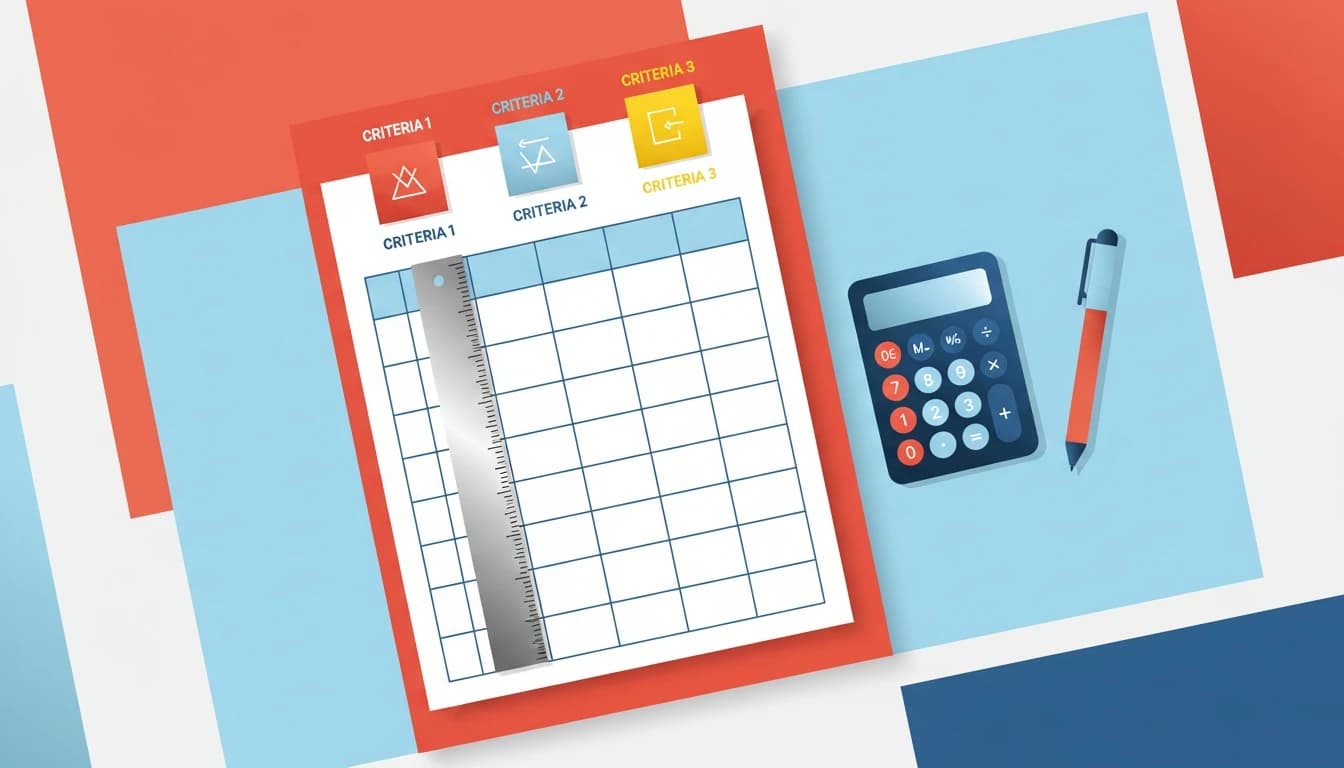
A tight set is usually 5-9 criteria. More than that and you start scoring noise. Here’s a compact criteria checklist I’ve used for vendor and product decisions:
Criterion
What “good” looks like
Common overlap trap
Total cost of ownership
All-in 24-month cost is low and predictable
Double-counting cost in “ROI”
Implementation effort
Weeks, not months; low internal load
Overlaps with “time to value”
Risk and compliance
Meets security/legal requirements
Overlaps with “vendor maturity”
User impact
Improves workflow quality and adoption
Overlaps with “ease of use”
Strategic fit
Supports roadmap and constraints
Overlaps with “future flexibility”
If you want a broader menu of frameworks (when a matrix is right vs when you need a different model), keep Decision Frameworks: the complete guide in your back pocket.
system analysis Step 3: Assign decision criteria weights (two methods that work)
system analysis gets real when you assign weights. The point is not mathematical perfection. The point is to express relative importance so the team stops pretending everything matters equally.
Method A: 100-point allocation (fastest in real teams)
Give stakeholders 100 points to distribute across criteria. If “Risk and compliance” is non-negotiable, it might get 30. If “Implementation effort” is annoying but tolerable, maybe 10.
This method exposes priorities quickly and reduces bikeshedding. It also gives you integer weights that are easy to explain.
Method B: Pairwise comparison (slower, more rigorous)
Compare criteria two at a time: “Which matters more, and by how much?” This is closer to formal MCDA and reduces anchoring, but it takes longer. If you want the academic version, the Analytic Hierarchy Process is the classic reference: Analytic hierarchy process (AHP).
My practical guidance: use 100-point allocation for most business decisions. Use pairwise comparison when stakes are high and politics are higher.
A weight sanity check I use: if changing a weight by 5-10 points would flip the winner, you don’t have a weight problem. You have an uncertainty problem, and you should gather more data.
decision matrix template Step 4: Build a scoring rubric (so people score consistently)
decision matrix template work fails when scoring is vibes-based. A scoring rubric is a short definition of what each score means.
Pick a scale and document it. I prefer 1-5 because it forces decisions without fake precision.
Example rubric for “Implementation effort”:
1 = 4+ months, heavy engineering + ops involvement
3 = 4-8 weeks, moderate internal effort
5 = 1-3 weeks, mostly configuration
This is where you reduce decision-making bias. Without a rubric, the loudest person defines what “5” means in the moment.
For bias awareness and how Google frames cognitive pitfalls, this is a good quick reference: cognitive bias overview.
system analysis Step 5: Normalize scores (when you must) and calculate totals
system analysis doesn’t always require normalization. It depends on your scoring inputs.
Use one of these approaches:
Approach 1: Rubric scoring (no normalization needed)
If every criterion is scored on the same 1-5 rubric, you can multiply score x weight directly.
Approach 2: Raw metrics (normalization required)
If you score using raw numbers (cost in dollars, time in weeks, uptime in percent), normalize to a common 0-1 or 0-100 scale so criteria are comparable.
A simple normalization that works well:
For “higher is better” metrics (uptime, revenue):
normalized = (x - min) / (max - min)
For “lower is better” metrics (cost, time):
normalized = (max - x) / (max - min)
Then compute:
Weighted total = Σ (normalized score x weight)
Here’s a worked decision matrix example with a 1-5 rubric (no normalization). Scenario: choose a support platform.
Criteria
Weight
Option A score
Option B score
Option C score
Total cost of ownership
25
4
2
3
Implementation effort
15
3
4
2
Risk and compliance
25
3
5
4
User impact
20
4
3
5
Strategic fit
15
3
4
4
Totals:
Option A = (4x25)+(3x15)+(3x25)+(4x20)+(3x15) = 100+45+75+80+45 = 345
Option B = (2x25)+(4x15)+(5x25)+(3x20)+(4x15) = 50+60+125+60+60 = 355
Option C = (3x25)+(2x15)+(4x25)+(5x20)+(4x15) = 75+30+100+100+60 = 365
Option C wins, but notice something important: B and C are close. That’s a signal to run sensitivity checks.
If you prefer to build this as a board that updates as context changes (new budget, new constraint, new option), that’s exactly the workflow Lucid supports: messy input in, structured options map out, then compare in grid/table/focus views. The reason it matters is consistency: the board stays coherent as you revise assumptions.
system analysis Step 6: Stress-test the result (sensitivity and failure modes)
system analysis is not “calculate once, declare victory.” You need to test whether the winner is robust.
Two fast checks:
Weight sensitivity: change the top 1-2 weights by +/- 10% and see if the ranking changes. If it flips, your decision is fragile.
Score challenge: ask, “Which single score would a skeptic dispute?” Then verify it with data (a trial, reference call, prototype, or benchmark).
Common failure modes I’ve seen in real decisions:
Double-counting criteria (cost + ROI + budget impact).
Scoring unknowns as if they’re known. Unknown should be a lower score or a risk penalty.
Letting one “pet criterion” sneak in late and tilt the matrix.
For teams that want a visual decision model, you can pair the matrix with a decision flowchart: first pass filters (hard constraints), then weighted scoring for the finalists. That hybrid is harder to game.
Turning the matrix into a decision you can defend
A weighted scoring model is only useful if you can explain it in one minute. State the decision, show the criteria and weights, then show the top two options and why the winner won.
If you want a clean way to capture the rationale so it doesn’t disappear after the meeting, we typically document: the criteria definitions, the rubric, the final table, and the sensitivity result. That artifact prevents rerunning the same debate next quarter.
When you’re ready to structure a real dilemma into an options board and compare paths side-by-side, start with a quick capture and let the board do the organizing. Create your first decision board in Lucid registration.