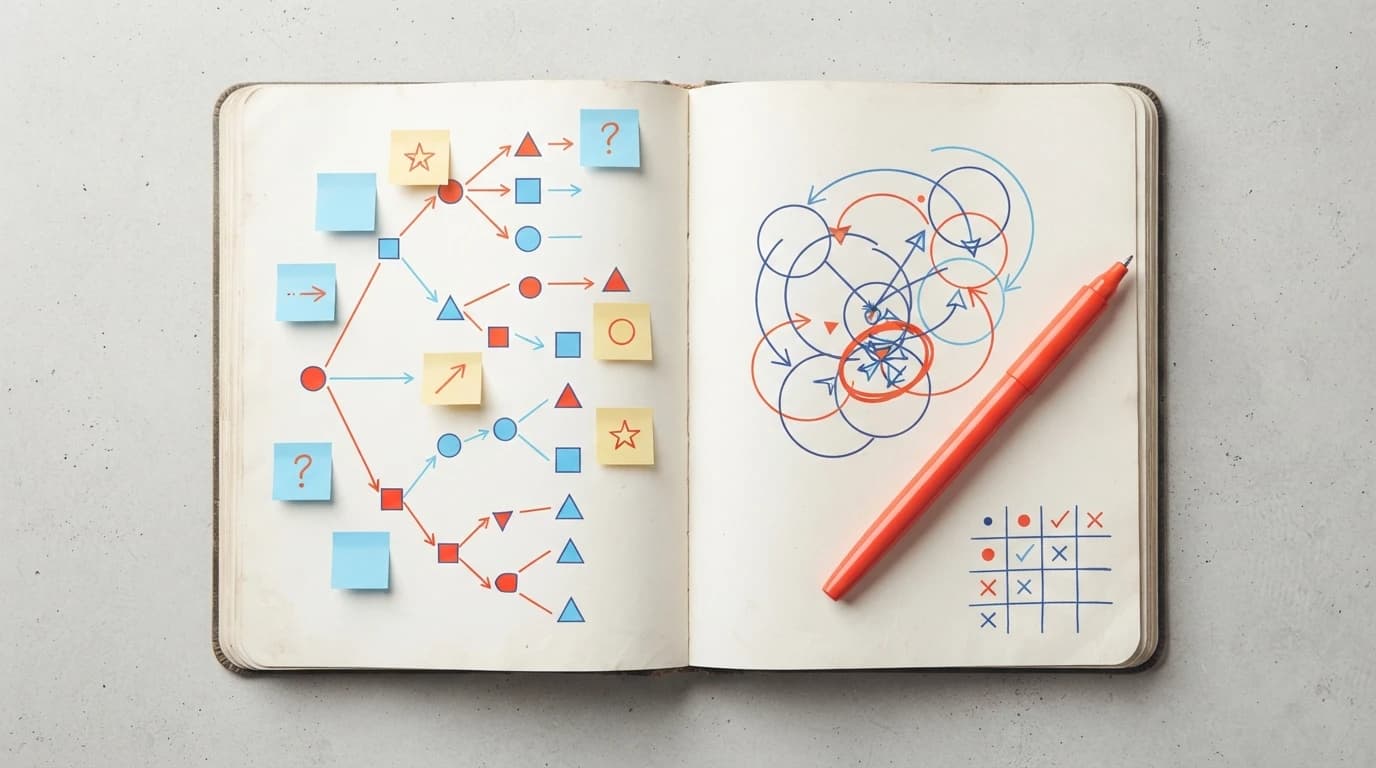
What Should a Scenario of Planning Actually Accomplish?

A scenario of planning should expose how a consequential decision performs under several plausible futures. Its output is a set of comparable paths: what the organization would do, what could invalidate that choice, which commitments are reversible, and what evidence should trigger a change.
The focal decision must be specific enough to assign. Consider a SaaS company deciding whether to build a regional hosting environment. "How might data regulation evolve?" is a research topic. "Should we commit engineering capacity to regional hosting, use a partner, or defer until customer demand crosses an agreed threshold?" is a focal decision.
A usable scenario charter contains the following elements:
| Element | Operational question | Weak version |
|---|
| Focal decision | What commitment must be approved, deferred, or rejected? | What might the market look like? |
| Decision owner | Who can authorize the response? | The leadership team |
| Time horizon | When would the major uncertainties resolve or matter? | The long term |
| Scope | Which markets, products, and dependencies are included? | Everything that could affect growth |
| Critical uncertainties | Which uncertain forces would materially change the decision? | A list of every known risk |
| Baseline assumptions | Which conditions are held constant across scenarios? | Hidden assumptions embedded in prose |
| Signposts | What observable evidence distinguishes one future from another? | General market updates |
| Trigger thresholds | What evidence forces review or action? | We will monitor developments |
The time horizon should match the commitment. A hiring decision may need a shorter horizon than a data-center contract or regulated product launch. If the selected horizon ends before the hard-to-reverse consequences appear, the exercise will systematically favor near-term convenience.
Scenario planning also needs a stable baseline. Contractual obligations, current cash constraints, existing technical architecture, and approved risk appetite should remain visible across every future unless one of them is deliberately chosen as an uncertainty. Changing assumptions quietly between narratives makes comparison meaningless.
The UK Government Office for Science describes scenarios within its Futures Toolkit for policy-makers and analysts as structured ways to examine possible futures rather than predictions. That distinction matters operationally: the facilitator is testing decisions against uncertainty, not trying to write the most persuasive story.
For a worked construction method, the scenario planning sample with a step-by-step example shows how raw forces become comparable futures.
Which Mistakes Make a Scenario of Planning Implausible or Redundant?
The most damaging scenario of planning mistakes occur before anyone writes the narrative. Teams choose a preferred outcome, vary superficial details around it, and then mistake polished language for strategic range.
Predetermined outcomes are the first failure. If executives already want the regional hosting build, facilitators may create one favorable future, one obviously catastrophic alternative, and one vague middle case. The exercise becomes retroactive justification. An effective control is to record disconfirming evidence beside every major assumption and give a named participant responsibility for challenging the favored path.
Dependent axes create redundant scenarios. Suppose a team uses "customer demand" on one axis and "sales growth" on the other. Those forces probably move together, so the resulting quadrants describe variations of the same commercial future. Better axes separate uncertainties with different causes, such as regulatory enforcement and enterprise willingness to pay for local hosting.
A simple quality test catches most weak scenario sets:
| Test | Pass condition | Failure signal |
|---|
| Independence | Each critical uncertainty can plausibly move without forcing the other | Both axes describe demand in different words |
| Distinctness | A decision would change between at least some scenarios | Every future leads to the same recommendation |
| Internal consistency | Events, incentives, and consequences can coexist | Low demand somehow produces rapid premium-price adoption |
| Decision relevance | The uncertainty changes timing, scale, sequence, or commitment | The story is interesting but leaves the choice untouched |
| Dissent test | Contradictory evidence is visible and evaluated | Only supporting market signals appear |
| Observability | Each future has measurable signposts | The scenario can only be recognized in hindsight |
Varying one factor also produces disguised sensitivity analysis. Raising and lowering demand while holding regulation, competitor behavior, capital cost, supplier capacity, and customer procurement unchanged may help test a model, but it does not expose interactions. Scenario work becomes valuable when it captures second-order consequences. Strict regulation might increase demand for regional hosting, attract new infrastructure partners, lengthen security reviews, and raise the value of an early compliance capability.
Wild cards require separate treatment. A sudden export restriction, infrastructure failure, or court ruling can be plausible enough to test while remaining too discontinuous to define the main scenario set. Use wild cards as stress tests against each core future. Do not allow an extreme event to consume the entire exercise unless the focal decision specifically concerns that shock.
Writing too many scenarios creates another control problem. Each narrative needs assumptions, consequences, indicators, options, and ownership. Use the smallest set that produces meaningfully different decisions; combining redundant futures is better than maintaining a scenario library nobody can monitor.
Cognitive bias compounds these design errors. Anchoring fixes attention on the current plan, confirmation bias filters evidence, and authority bias discourages challenges to executive assumptions. The decision-making bias controls and tools provide practical checks for evidence collection and review roles.
Why Do Teams Confuse Scenarios With Forecasts and Contingency Plans?
A forecast estimates what is likely to happen. A scenario explores what could plausibly happen and asks whether the decision survives. A contingency plan specifies what the organization will do if a defined event occurs.
The confusion usually starts when sponsors ask which scenario is "most likely." Teams then attach probabilities without enough evidence, rank the narratives, and return to a single expected future. That destroys the purpose of examining uncertainty.
| Method | Primary question | Typical output | Appropriate use |
|---|
| Forecast | What is likely to happen? | Point estimate or range | Demand, capacity, revenue, or workload planning where historical patterns remain informative |
| Scenario planning | What plausible futures could materially alter the decision? | Distinct futures, signposts, and response options | Structural uncertainty, interacting forces, or long-lived commitments |
| Contingency planning | What will we do if a defined event occurs? | Action plan, owner, and escalation path | Outages, supplier failure, compliance breach, or other identifiable events |
| Sensitivity analysis | Which input changes the result most? | Model outputs under changed assumptions | Testing numerical model dependence |
| Real options analysis | What is the value of preserving the right to act later? | Staged commitment or option value | Irreversible investments with information arriving over time |
Probability can be justified when there is a credible reference class, stable measurement, and defensible data. Most strategic scenarios lack those conditions. Labels such as "forty percent likely" often represent executive confidence dressed as measurement, especially when the futures arise from unprecedented regulatory or technological shifts.
Use confidence labels only when the method is documented. Otherwise, compare each scenario using evidence quality, internal consistency, decision impact, and observable signposts. Teams considering staged pilots, contractual options, or delayed investment can apply real options analysis to decisions under uncertainty instead of forcing a premature yes-or-no commitment.
Forecasts can still sit inside scenarios. A team may model demand ranges within each regulatory future, provided the assumptions stay visible. Contingency plans can also emerge from scenarios once a trigger becomes specific enough to assign. The methods complement each other when their jobs remain separate.
How Can a Weak Scenario of Planning Be Repaired Before Approval?
A weak scenario of planning can be repaired by returning to the decision contract, rebuilding the uncertainty structure, and converting narrative consequences into monitored commitments. Do this before executives debate which story they prefer.
Use this sequence in order:
- Rewrite the focal decision. Name the choice, accountable owner, approval date, available paths, and hard-to-reverse commitments. If the sentence cannot distinguish approval from deferral, it remains too broad.
- Audit assumptions and driving forces. Separate predetermined conditions from critical uncertainties. Record the evidence source, dissenting evidence, and the condition that would invalidate each major assumption.
- Rebuild the scenario logic. Choose uncertainties that are both decision-relevant and sufficiently independent. Merge redundant futures and remove any narrative that exists only to make the preferred option look safe.
- Trace consequences. For each future, map direct effects, second-order effects, stakeholder reactions, constraints, and potential feedback loops. Check the causal chain rather than accepting fluent prose.
- Attach decisions and monitoring. Compare response options, identify reversible steps, assign scenario owners, define signposts, and set trigger thresholds that require review.
A repair gate should look like an approval control, not an editorial review:
| Approval question | Evidence required |
|---|
| Would different futures change the decision? | A comparison showing which option wins, fails, or needs staging under each scenario |
| Can the organization recognize change early? | Named indicators, data sources, review cadence, and threshold definitions |
| Are commitments proportionate to uncertainty? | Reversible steps separated from sunk or contractual commitments |
| Is challenge built into the process? | Dissenting evidence and an independent reviewer or red-team role |
| Will someone maintain the work? | Scenario owner, decision owner, and scheduled review event |
| Can changed constraints update every path? | Documented assumptions and dependencies rather than disconnected prose |
Trigger thresholds must be tied to action. "Monitor enterprise demand" is too weak. A useful definition specifies the indicator, source, observation period, and response: for example, a sustained rise in qualified regional-hosting requirements prompts a capacity review, while a binding regulatory deadline triggers legal and architecture approval.
Be careful with false precision. A threshold should reflect a real economic, operational, or compliance boundary, such as lead time, contract exposure, minimum viable capacity, or approved risk tolerance. An arbitrary round number simply relocates the unsupported assumption.
What Is a Decision Support System DSS Used for Here?
The query what is decision support system DSS refers to software that organizes data, assumptions, alternatives, and analytical models so people can make a better-grounded choice. In scenario work, a DSS should preserve traceability between a changed constraint and the options, consequences, indicators, or scores affected by that change.
Decision making tree software can represent sequential choices and uncertain events well, particularly when paths have clear branching conditions. Collaborative decision-making software is more useful when multiple functions must challenge assumptions, compare tradeoffs, and maintain shared ownership.
Lucid converts a written or recorded dilemma into a color-coded options map with advantages, disadvantages, and future consequences. Grid, Table, and Focus views support different comparison tasks, while adding context or changing a constraint refines the available paths. That is useful after the scenario logic has been disciplined; software cannot rescue biased axes or an undefined focal decision.
When teams convert response options into scored criteria, they should also avoid the weighting and scale errors covered in common decision matrix mistakes and their controls. The matrix supports comparison. It should not conceal uncertainty behind a single total.
Frequently Asked Questions
What are the three types of scenarios?
A common classification is exploratory, normative, and predictive scenarios. Exploratory scenarios ask what could happen, normative scenarios work backward from a desired future, and predictive scenarios estimate what is likely; decision-focused planning usually relies most heavily on exploratory scenarios.
What is another term for scenario planning?
Strategic foresight and scenario analysis are often used as related terms, although they are not exact synonyms. Strategic foresight covers a wider set of methods, while scenario analysis focuses on constructing and comparing plausible futures.
What is a scenario planning process?
A scenario planning process defines a focal decision and horizon, identifies driving forces, isolates critical uncertainties, constructs plausible futures, tests response options, and establishes signposts. The process remains useful only when owners revisit it as evidence and constraints change.
How many scenarios should a team create?
Use the smallest number that produces genuinely different operating choices. A scenario adds value when it changes timing, commitment, sequencing, or risk treatment; redundant narratives should be merged.
Should scenarios have probabilities?
Only when a credible dataset, reference class, and documented estimation method support them. For structural uncertainties without reliable frequency data, use plausibility, evidence quality, signposts, and decision impact rather than invented percentages.
A credible scenario exercise ends with a decision owner, monitored indicators, and options that remain workable when conditions shift. If your current analysis is trapped in notes and disconnected narratives, register for Lucid to structure the dilemma, compare its paths, and update the decision when a constraint changes.