What should analysis of options and recommendation examples contain?
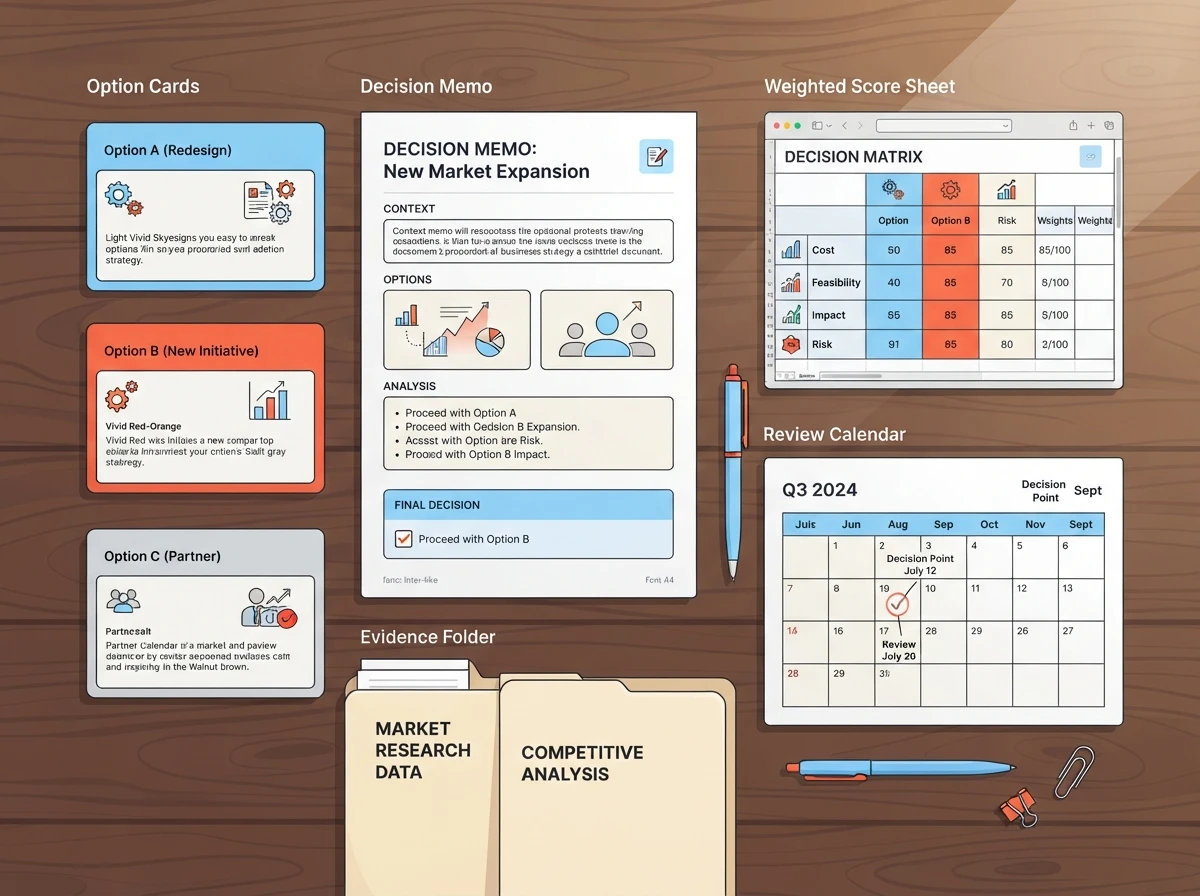
An options analysis should contain a precise decision statement, viable alternatives, decision criteria, evidence, comparative scoring, trade-offs, uncertainty, rejected options, and an explicit recommendation. It should also identify who decides, what must happen before implementation, and when the choice should be reviewed.
The purpose is defensibility. A reviewer should be able to reconstruct why one path was preferred without attending the original meeting or relying on the author's memory.
| Document field | What to write | Control question |
|---|
| Decision statement | The choice, decision owner, deadline, and intended outcome | What approval is actually being requested? |
| Constraints | Budget ceiling, delivery date, regulatory obligation, capacity limit, or technical dependency | Which conditions cannot be traded away? |
| Viable options | Mutually distinct paths, including maintaining the current state when credible | Could each option realistically be approved and executed? |
| Criteria and weights | Measures tied to the decision outcome, with definitions and relative importance | Would two reviewers score the same evidence consistently? |
| Evidence | Verified facts, source dates, forecasts, and assumptions | What is known, estimated, or still missing? |
| Trade-off analysis | Advantages, disadvantages, consequences, and residual risk | What does the preferred option sacrifice? |
| Sensitivity check | Changes to weights, assumptions, or scenarios that could alter the ranking | How stable is the result? |
| Recommendation | Selected path and concise rationale | Why is this option better under the stated conditions? |
| Implementation conditions | Controls, approvals, pilots, contract terms, or hiring gates | What must be true before commitment? |
| Governance | Decision owner, action owner, review date, and revisit evidence | Who can reopen the decision, and on what evidence? |
A scoring table supports the narrative but does not replace it. Teams needing a full scoring method can use the process for building a weighted decision matrix, while more complex decisions may require the broader methods in this multiple criteria decision analysis guide.
An Excel decision matrix template can calculate totals, but spreadsheets often hide reasoning inside formulas, comments, and private assumptions. Keep the recommendation narrative beside the score, and record the evidence used for each rating.
How do analysis of options and recommendation examples move from criteria to a recommendation?
A decision matrix example becomes defensible when every score traces back to a defined criterion and a specific piece of evidence. The recommendation then explains why the leading option's advantages justify its disadvantages, rather than merely reporting the highest total.
Use this sequence:
- Define the decision and eliminate options that violate non-negotiable constraints.
- Set criteria before detailed vendor proposals or stakeholder lobbying can anchor the analysis.
- Define the scoring scale in observable terms, then assign weights based on business consequences.
- Score documented evidence and label assumptions where evidence is incomplete.
- test whether reasonable changes to weights, costs, or forecasts alter the preferred option.
- Write the recommendation with implementation conditions, residual risks, and revisit triggers.
Worked vendor selection example
Assume an operations team must select a workflow platform before its current contract renewal. Three options remain viable: Vendor A, Vendor B, or an internal build. The following figures are hypothetical and illustrate the calculation rather than provide market benchmarks.
Ratings use a five-point scale, where one means the option materially fails the criterion and five means it satisfies the criterion with verified evidence.
| Criterion | Weight | Vendor A | Vendor B | Internal build |
|---|
| Security and compliance fit | 30% | 5 | 4 | 5 |
| Workflow coverage | 25% | 4 | 5 | 3 |
| Integration fit | 20% | 3 | 4 | 5 |
| Total cost exposure | 15% | 2 | 3 | 1 |
| Exit flexibility | 10% | 4 | 2 | 5 |
| Weighted result | 100% | 3.80 | 3.90 | 3.80 |
Facts: Vendor B demonstrated the required workflows and supported the priority integrations during evaluation. Its termination terms were less favorable than Vendor A's, and one security control required remediation.
Forecasts: The cost estimate assumes the current user count and expected integration effort. Internal build estimates depend on engineering capacity remaining available after the next planning cycle.
Rejected alternatives: Vendor A loses narrowly because weaker integration coverage and higher expected operating cost offset its stronger security position. Internal build offers control and exit flexibility but creates delivery and maintenance exposure.
Recommendation: Select Vendor B subject to security remediation being accepted by the risk owner and stronger exit terms being negotiated before signature. If security weight increases from 30% to 40% while workflow coverage falls from 25% to 15%, Vendor A becomes the preferred option. That sensitivity result belongs in the approval memo because the recommendation depends on the current risk appetite.
For an implementation-focused variation, the tool-selection decision matrix example covers how to translate operational requirements into comparable ratings.
Recommendation examples for product, staffing, build-buy, and risk decisions
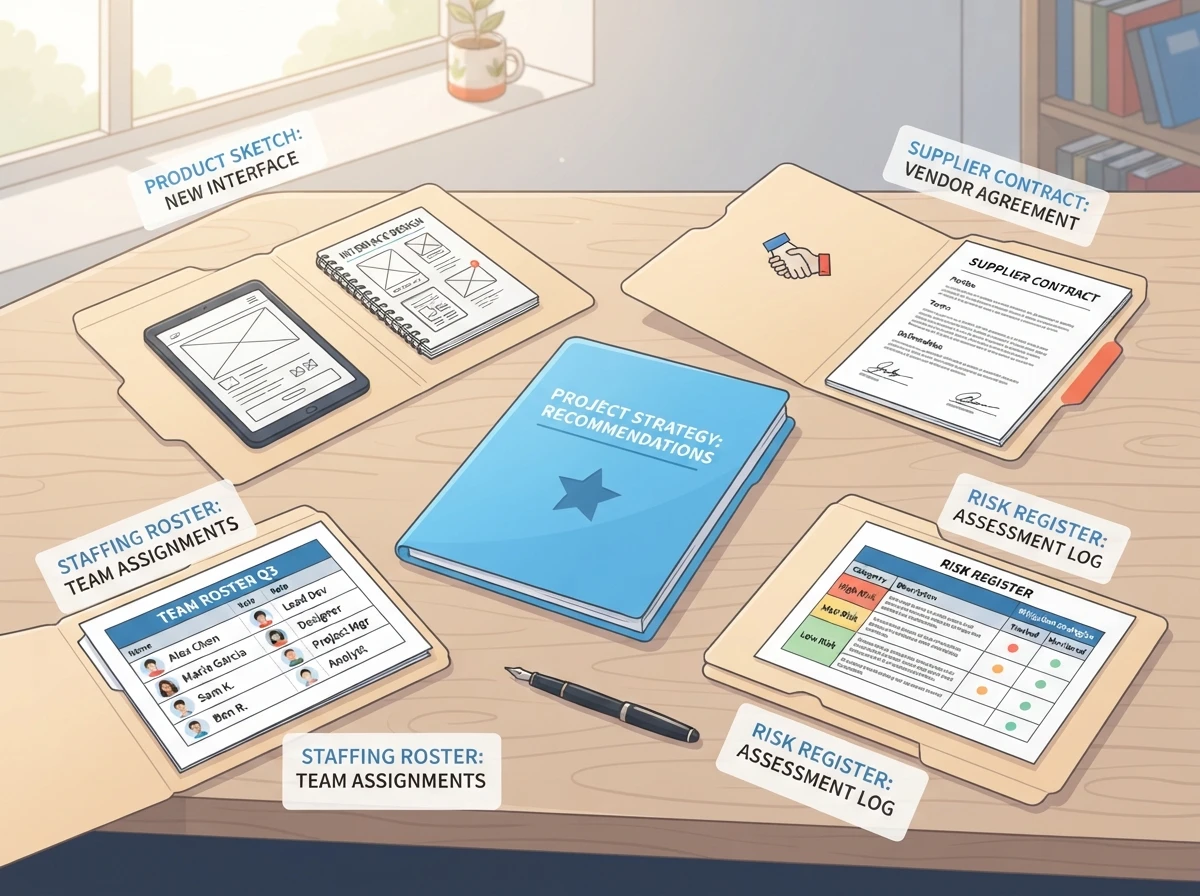
Real options analysis is useful when a small, reversible commitment can preserve access to a larger opportunity. Rather than forcing an immediate all-or-nothing choice, the recommendation can fund evidence gathering and defer irreversible investment until uncertainty falls.
The same principle applies across product, staffing, build-versus-buy, and risk treatment decisions. Each example below distinguishes evidence from prediction and makes the rejected path visible.
| Decision | Facts and forecasts | Rejected alternatives | Recommendation and future consequence |
|---|
| Feature investment | Facts: enterprise prospects repeatedly request audit exports. Forecast: the capability may improve conversion, but sales impact remains unverified. | Full development commits a quarter before demand is proven. Deferral preserves capacity but may weaken active deals. | Fund a limited discovery and prototype stage. Proceed to full build only if named prospects validate the workflow and commercial owners confirm deal relevance. |
| Staffing | Facts: incident response depends on two specialists, and planned work regularly competes with urgent support. Forecast: demand may rise after expansion. | Immediate permanent hiring adds fixed cost before workload is stable. Continued overtime increases concentration and retention risk. | Approve temporary specialist capacity while measuring queue volume and skill demand. Revisit permanent hiring on a specified review date using workload evidence. |
| Build versus buy | Facts: a vendor meets standard requirements, while the internal option offers deeper customization. Forecast: custom maintenance demand is uncertain. | Building creates schedule and ownership risk. Buying introduces dependency, renewal exposure, and switching cost. | Buy for standard capabilities, retain data portability, and isolate custom logic behind controlled interfaces. Reassess if vendor constraints block a material workflow. |
| Risk treatment | Facts: a recurring processing error has known causes and measurable operational impact. Forecast: automation should reduce frequency, though exceptions will remain. |
A product prioritization framework should produce the same kind of recommendation record. A high score alone says little when an initiative depends on uncertain adoption, unavailable engineering skills, or a legal review that has not started.
Build-versus-buy decisions deserve particular care because cost models often understate internal maintenance and overstate vendor reversibility. The build-versus-buy guide for AI investment provides a deeper treatment of ownership, dependency, and long-term operating exposure.
How should uncertainty and dissent be documented?
Scenario planning examples are useful when a recommendation performs differently under plausible future conditions. Document the base case, a credible adverse case, and the variables that would trigger a different action. Avoid creating elaborate scenarios that do not affect the choice.
The UK government's Green Book guidance on appraisal and evaluation requires decision analysis to address risk, uncertainty, and optimism bias. For operational recommendations, that means showing where estimates may be systematically favorable and testing the consequences.
| Uncertainty field | Required entry | Example |
|---|
| Assumption | A statement currently treated as true | Integration work will fit within the planned release window |
| Evidence status | Verified, partially verified, or forecast | Partially verified through technical discovery |
| Decision effect | How failure changes the recommendation | A longer integration period removes the cost advantage |
| Trigger | Observable evidence that requires review | Vendor estimate exceeds the approved delivery window |
| Response | Predetermined action | Reopen Vendor A comparison or reduce initial scope |
| Owner and date | Person accountable for checking the trigger | Program owner at contract and design review |
Risk language should also stay consistent. The NIST Guide for Conducting Risk Assessments distinguishes sources of threat, events, vulnerabilities, likelihood, and impact. Even outside cybersecurity, that separation prevents teams from burying several different judgments inside a single label such as "high risk."
Record dissent in the decision document, not only in meeting minutes. State the dissenting position, the evidence supporting it, whether it changes the recommendation, and who accepted the unresolved exposure. I treat a well-supported minority view as decision evidence because it often identifies the assumption most worth monitoring.
A short pre-mortem can expose hidden failure paths before approval. Gary Klein's project pre-mortem method in Harvard Business Review asks participants to assume the decision failed and explain why, which makes concerns easier to raise before hierarchy and commitment suppress them.
Lucid supports this work by converting an unstructured dilemma into an options map, then refining advantages, disadvantages, and future consequences when users add context or change a constraint. Grid, Table, and Focus views provide different ways to inspect the same comparison without maintaining separate analyses.
What common writing mistakes weaken the final recommendation?
Decision-making bias usually enters a recommendation through option framing, selective evidence, inconsistent scoring, or premature commitment. The writing can look rigorous while still protecting a favored answer.
| Weak practice | Why it fails | Corrective control |
|---|
| Starting with the preferred option | Criteria become tailored to justify an existing preference | Agree on constraints and criteria before scoring |
| Mixing facts with forecasts | Reviewers cannot identify which claims require validation | Label each material claim by evidence status and date |
| Using vague criteria such as "strategic fit" | Different reviewers apply different meanings | Define observable scoring anchors |
| Hiding eliminated options | Reviewers cannot assess whether the option set was artificially narrowed | Record each rejected path and the reason for exclusion |
| Reporting only the total score | Small numerical differences appear more decisive than they are | Explain trade-offs and run a sensitivity check |
| Omitting the status quo | Change receives less scrutiny than continued operation | Treat continuation as an option when it is operationally viable |
| Ignoring residual risk | Approval is mistaken for complete risk removal |
A common failure is double counting. For example, scoring "security," "regulatory compliance," and "risk reduction" separately may reward the same control three times. The common decision matrix mistakes and corrections explains how overlapping criteria distort totals.
Anchoring, confirmation bias, and authority bias also affect which evidence reaches the document. Teams can use a decision-making bias checklist for structured reviews before final approval, especially when the recommendation sponsor also controls the analysis.
Frequently Asked Questions
What is the 10-10-10 rule for decisions?
The 10-10-10 rule, associated with Suzy Welch, asks how a decision may feel or perform in 10 minutes, 10 months, and 10 years. It is useful for exposing future consequences, but it does not replace criteria, evidence, or risk analysis.
What is the most famous decision matrix?
The Eisenhower Matrix is widely recognized for prioritizing work by urgency and importance. For selecting among competing solutions, a weighted decision matrix or Pugh matrix is usually more appropriate because it compares alternatives against several defined criteria.
What are some examples of decision-making tools?
Common tools include weighted matrices, decision trees, cost-benefit analysis, scenario planning, pre-mortems, real options analysis, and risk matrices. The right tool depends on whether the decision is driven mainly by multiple criteria, uncertain events, timing, or risk exposure.
What is a decision support system?
A decision support system is a tool that organizes data, models, assumptions, and alternatives to help a person or team make a choice. It supports judgment rather than owning the decision or accepting its consequences.
Should a recommendation always select the highest-scoring option?
No. A lower-scoring option may be preferable when the numerical leader violates a constraint, relies on weak evidence, or performs poorly under a credible adverse scenario. Explain the override explicitly and identify who authorized it.
A defensible recommendation leaves a usable record: what was decided, why the trade-off was acceptable, what could invalidate the choice, and who must respond. To turn an active dilemma into a structured comparison of options and future consequences, register for Lucid and map the decision before commitment hardens.