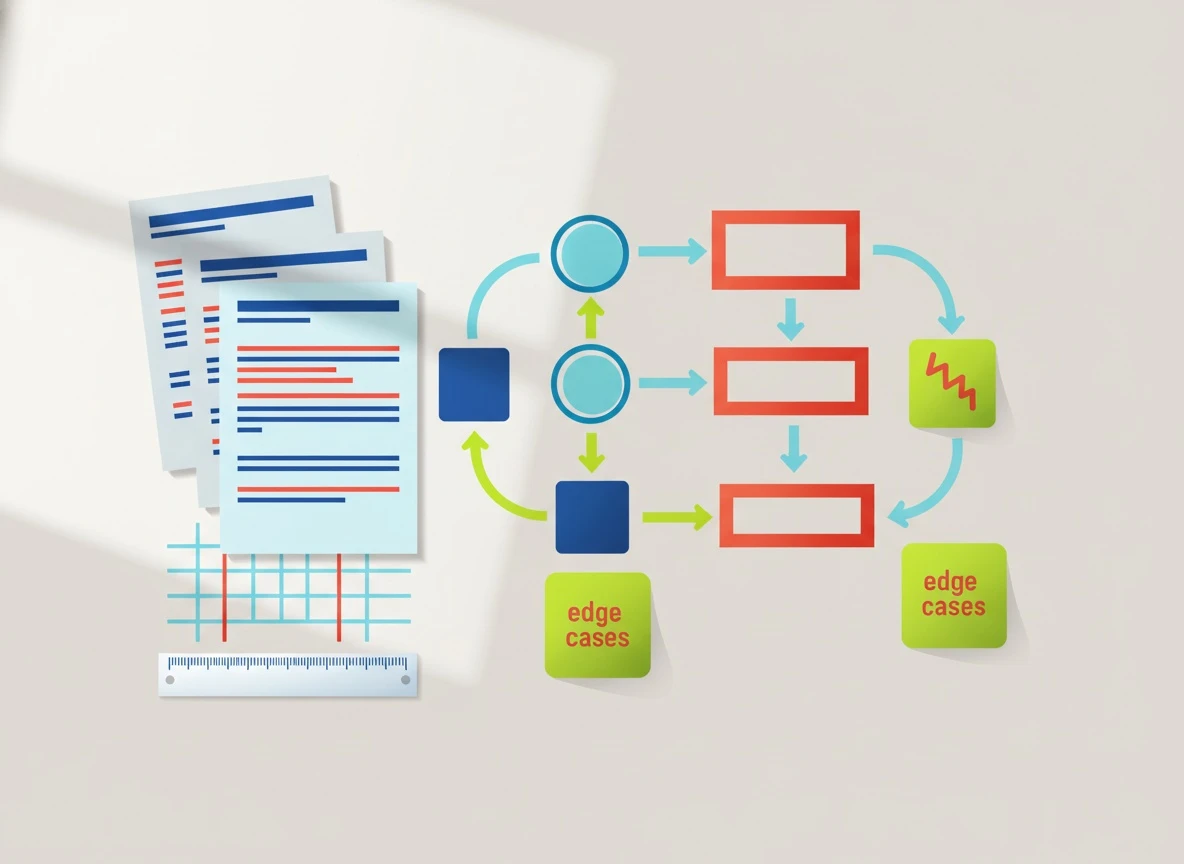
System Analysis vs Business Analysis: Key Differences
9 min read
System analysis vs business analysis comes down to this: business analysis defines the right problem and outcomes, while system analysis designs and validates the right system behavior to deliver them. This guide breaks down scope, stakeholders, deliverables, requirements, process analysis, and technical constraints so your project stops shipping mismatched specs.
System analysis vs business analysis: the fastest way to tell them apart
System analysis is the discipline of understanding a system end-to-end so you can specify how it should behave under real constraints: integrations, data flows, rules, performance, and failure modes. Business analysis is the discipline of understanding the business need so you can define outcomes, value, and process changes that justify building anything at all.
If you only remember one line, use this: Business analysis proves what should change and why. System analysis proves what must be built and how it will work.
I have seen projects lose months because teams used the same word, “requirements,” to mean two different things. The BA wrote outcome-focused needs, the engineering team expected interface and data specs, and everyone thought the other side “missed details.” That is not a people problem. It is a definition problem.
Requirements: business needs vs system requirements (and where teams slip)
Business analysis requirements describe business goals, user needs, policies, and success metrics. They answer: “What outcome do we need, and what constraints exist in the business environment?” They are often expressed as capabilities, user journeys, acceptance criteria, and measurable KPIs.
System analysis requirements translate those needs into system behavior that can be designed, built, and tested. They answer: “What data moves where, what rules apply, what integrations are required, and what happens when something fails?”
Here is the practical split I use to prevent confusion:
Requirement type
Owned by (primary)
Example
Validation method
Business outcome
Business analysis
“Reduce onboarding time from 5 days to 2 days”
KPI tracking, stakeholder sign-off
Process rule
Business analysis
“Approvals required for orders above $10k”
Policy review, workflow walkthrough
Functional behavior
System analysis
“System routes approvals to role-based queue within 30 seconds”
Test cases, QA verification
Data and integration
System analysis
“Sync customer status to CRM via webhook with retries”
Integration tests, monitoring
Non-functional
System analysis
“99.9% availability, P95 response < 500ms”
Load tests, SLOs
A common failure mode is treating business requirements as if they are build-ready. They are not. Another is letting system requirements drive the project before the business outcome is even agreed. That is how you get technically elegant work that nobody adopts.
When you feel that “analysis paralysis” creeping in, it usually means the team is mixing layers. A BA question like “Who owns this process?” cannot be solved by drawing more architecture. A system analysis question like “What is the source of truth for customer status?” cannot be solved by more stakeholder interviews. Treat them as different analysis questions with different evidence.
Stakeholders: who you work with and what they expect back
Business analysis lives with stakeholders who can define value and authorize change: process owners, finance, sales ops, compliance, customer support, end users, and executives. The BA’s output needs to be legible to non-technical decision makers.
System analysis sits closer to the people who can make the system real: engineering, QA, security, data, IT operations, vendors, and sometimes enterprise architects. The system analyst’s output must be unambiguous enough to build and test.
This is where teams get burned: the BA hands a “requirements doc” to engineering, engineering asks for edge cases and data definitions, and the BA thinks engineering is “overcomplicating it.” In reality, engineering is asking for system analysis deliverables.
If you are leading a team decision about roles, it helps to explicitly pick a decision framework for who owns what. We have a practical guide on how to choose a decision framework for your team that maps ownership to decision types, not job titles.
Deliverables: what “done” looks like for each role
Business analysis deliverables are about clarity and alignment. System analysis deliverables are about buildability and testability.
In real projects, I look for these “definition of done” artifacts:
Area
Business analysis deliverables
System analysis deliverables
Problem framing
Problem statement, scope boundaries, value hypothesis
System boundary definition, context diagram
User and process
As-is and to-be process analysis, personas, journey maps
Use case flows, state transitions, exception handling
Requirements
Business requirements, acceptance criteria, priority
Functional specs, interface contracts, data model notes
Risk and compliance
Policy constraints, audit needs, change impacts
Threat considerations, logging/monitoring needs
Decision traceability
Rationale for tradeoffs
Traceability matrix from business needs to system behaviors
A strong team keeps a clean chain from “why” to “what” to “how.” When that chain breaks, you get scope creep, rework, or a system that meets the spec but fails in production because the real-world exceptions were never modeled.
If you want a structured way to keep tradeoffs visible, Lucid’s decision board approach is built for side-by-side comparisons and consequences. Even if you do not use Lucid, the structure is worth copying: options, pros/cons, downstream impacts, and what would change your mind. That same structure is what prevents “we decided this in a meeting” from becoming your only documentation. (Related: our broader overview of decision frameworks and when to use them.)
Solution design: where business analysis stops and system analysis starts
Solution design is where role confusion gets expensive.
Business analysis participates in solutioning, but typically at the level of evaluating options against outcomes: buy vs build, process change vs automation, phased rollout vs big bang, and the operating model needed to make it stick.
System analysis owns the translation from chosen option into coherent system behavior: components, data contracts, workflows, error handling, and performance characteristics. This is where decision logic becomes explicit. If you cannot express the rules clearly, you cannot test them.
A useful technique here is a “solution tree” that starts with the business goal, then branches into solution approaches, then into system behaviors and dependencies. When teams skip the middle layer, they jump from goal straight to architecture, and the first time a stakeholder sees it they say, “That is not what we meant.”
For teams that like visual comparisons, a decision making matrix can quickly separate business-fit from system feasibility:
Criterion
Business analysis lens
System analysis lens
Value
Revenue, cost, risk reduction
Delivery impact of value assumptions
Feasibility
Organizational readiness
Integration complexity, data readiness
Time
Change management timeline
Build and test timeline
Risk
Compliance and adoption
Reliability, security, operational risk
When you need to pressure-test consequences, scenario analysis belongs in the workflow. Ask “What happens if volume doubles?” and “What happens when a dependency is down?” Those are system analysis questions that protect you from happy-path specs.
Process analysis vs technical constraints: choosing the right tool for the job
Process analysis is the BA’s home turf. The best BAs I have worked with can walk a messy real-world workflow and surface the truth nobody wrote down: handoffs, exceptions, and incentives. That is how you prevent building software that forces people into workarounds on day one.
Technical constraints are the system analyst’s home turf. Constraints are not just “the tech stack.” They include data quality, latency, identity and access, vendor limits, API quotas, and operational realities like on-call and monitoring.
When deciding which analysis you need first, use this rule:
If the risk is “we build the wrong thing,” start with business analysis and process analysis.
If the risk is “we cannot build it reliably,” start with system analysis and constraints discovery.
Google’s own engineering reliability guidance is blunt about why constraints matter: reliability is designed, not patched in later. Their Site Reliability Engineering principles are worth skimming if your project has production risk.
A practical handoff workflow (so deliverables do not mismatch)
Most teams do not need a debate about titles. They need a handoff that keeps meaning intact across roles.
Here is the workflow I have used to stop the “requirements ping-pong” cycle. Order matters, because it prevents premature design and late discovery of constraints.
Business analysis frames the outcome and scope. Define success metrics, in-scope and out-of-scope, and the process changes required. Lock the vocabulary: what terms mean what.
System analysis defines the system boundary and dependencies. Identify source-of-truth systems, integrations, data ownership, and non-functional requirements.
Jointly map options and tradeoffs. Use a decision flowchart for major forks (manual vs automated, sync vs async, centralized vs distributed). Document why you chose the path you chose.
System analysis produces build-ready specs and test conditions. Include edge cases, error handling, and observability requirements.
Business analysis validates the solution against outcomes. Run stakeholder walkthroughs and confirm the to-be process actually works for humans, not just diagrams.
If your team struggles to keep options straight, Lucid is designed for exactly this moment: messy inputs become an options map with pros, cons, and future consequences, then you compare in board views until the path is obvious. When you are ready, you can turn the chosen path into specs without losing the reasoning. (If you are exploring AI support roles, our roundup of real-world conversational AI app use cases helps set expectations.)
A standalone truth worth repeating: If the team cannot explain why an option was rejected, the decision will be reopened later under pressure.
Next step: prevent role confusion before the kickoff meeting
Before your next project kickoff, take 20 minutes and write two one-sentence statements: the business outcome (BA-owned) and the system behavior change (system analysis-owned). If you cannot write both, you are not ready to estimate, commit, or design.
If you want a faster way to turn a messy dilemma into a structured options board with pros/cons and consequences, start a Lucid decision board and keep the reasoning attached to the work from day one: create a Lucid account to build your first decision board.