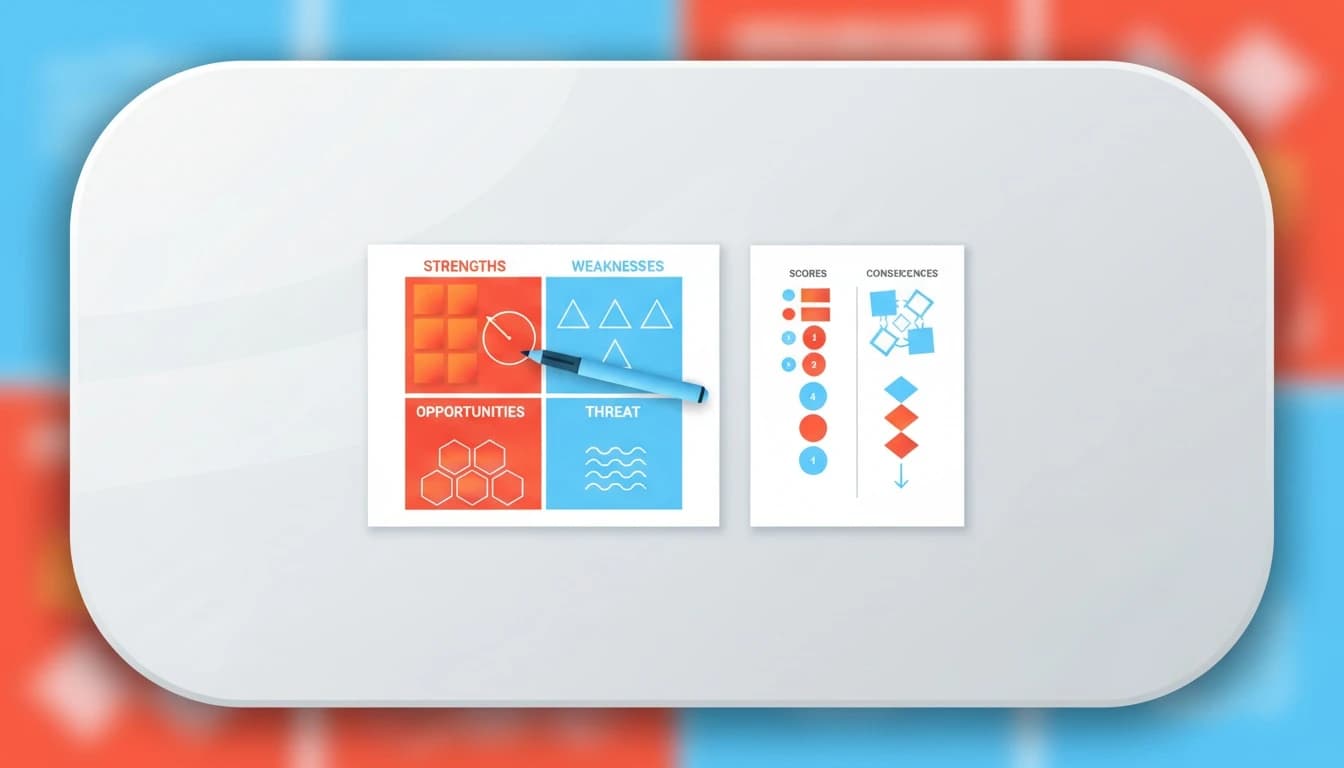
A swot analysis example should change what you do next. If your team keeps producing “nice SWOTs” that feel smart but don’t move a decision, it’s usually because the matrix is vague, unproven, and disconnected from tradeoffs. This playbook shows the most common SWOT failure modes and how to fix them with evidence, scoring, and consequence mapping.
Which SWOT analysis mistakes create false confidence?
The most dangerous SWOTs are the ones that look polished. They create a false sense of coverage: “We considered everything.” In practice, they often hide the exact uncertainties that should drive the decision.
Here are the failure modes I see most often when teams bring me a SWOT that “didn’t help”:
Mistake 1: Treating SWOT as a brainstorming artifact instead of a decision tool.
If the SWOT ends with “and therefore… we should do X” without showing the tradeoffs, it’s not decision logic. It’s narrative.
Mistake 2: Mixing levels of analysis in the same quadrant.
A strength like “great culture” sitting next to “gross margin 72%” makes the SWOT impossible to act on. One is a fuzzy internal vibe, the other is a financial advantage with a clear lever. When levels mix, the team debates semantics, not strategy.
Mistake 3: Missing constraints and assuming away the hard parts.
A SWOT that ignores hiring capacity, budget ceilings, regulatory realities, or integration debt is basically fan fiction. Constraints are not “negativity.” They are the boundary conditions of the decision.
Mistake 4: Biased competitor analysis (or none at all).
Opportunities like “expand to enterprise” are meaningless without a competitor map: who already owns the buyer, what switching costs exist, and what they will do in response. A SWOT that doesn’t model competitor reaction turns into wishful thinking. Michael Porter’s core point holds up: competitive advantage is relative, not absolute ().
Mistake 5: Unranked threats that all look equally scary.
If every threat is “high risk,” you get paralysis. If no threat has likelihood, impact, and time horizon, you can’t plan mitigations or decide whether to accept the risk.
A clean way to diagnose this: if two smart stakeholders can read your SWOT and still argue for opposite decisions, the SWOT is not structured enough to constrain the choice.
When teams need a shared structure that forces tradeoffs, I’ll often pair SWOT with a decision framework. If you want a quick way to pick the right structure before you start, use Lucid’s guide on how to choose a decision framework for your team.
How do you avoid vague strengths and generic opportunities?
A SWOT fails when it becomes a list of adjectives. “Strong brand.” “Great team.” “Growing market.” Those are not decision inputs because they don’t imply a lever or a bet.
The fix is to enforce a formatting rule: every item must be a claim that can be disproven.
Example rewrites that turn fluff into something you can evaluate:
Weak SWOT item
Decision-grade rewrite
What you can do with it
“Strong brand”
“Unaided recall is higher than our top 3 competitors in mid-market IT buyers, based on last quarter’s survey.”
Decide whether brand can carry a premium price or faster sales cycle.
“Great product”
“Activation-to-week-4 retention is 18 points higher than category benchmarks for teams over 20 seats.”
Decide whether to push upmarket or fix onboarding for small teams.
“Growing market”
“Spend in segment X is projected to grow 12% YoY, but procurement cycles are lengthening by 20%.”
Decide whether growth offsets sales friction or requires channel changes.
If you don’t have the data yet, you can still write the item, but it must be labeled as an assumption and paired with a test. Otherwise, it becomes a permanent zombie bullet that nobody challenges.
This is also where a SWOT template helps, but not the typical four empty boxes. Your template should force specificity with fields for scope, metric, and source. If you already use decision templates internally, align them with a coherent system. Lucid’s Decision Frameworks: The Complete Guide is a solid reference library for that alignment.
What evidence should sit behind each SWOT item?
A SWOT item without evidence is just a team’s collective mood. Evidence doesn’t need to be perfect, but it must be explicit so people can challenge it.
I recommend a “minimum evidence bar” per quadrant:
To keep this practical, I ask teams to attach one of the following evidence types to every item:
A number (metric, benchmark, trend) with a timeframe.
A source (survey, CRM report, finance model, support tags, research note).
A quote (verbatim customer line, win-loss insight, procurement objection).
A constraint (budget cap, headcount limit, integration dependency, compliance rule).
That’s it. If none apply, the item is not decision-grade.
Two external sources worth using to keep evidence honest:
First, if you’re citing market size or growth, don’t hand-wave. Use a reputable dataset provider or a well-sourced industry report, and document your assumptions. Second, when you’re tempted to “average” outcomes without understanding variance, remember that uncertainty is often the real story. A quick refresher on why variance matters is helpful even for non-statisticians (Wikipedia: analysis of variance).
One more point that changes behavior: separate “we believe” from “we know.” Teams stop arguing when they see which bullets are facts and which are hypotheses.
How do you turn SWOT into measurable decision criteria?
A SWOT is a diagnosis. A decision requires criteria, weights, and thresholds. This is where most teams stop short.
The simplest conversion is:
Translate each relevant SWOT item into a criterion.
Weight criteria based on strategy and constraints.
Score each option.
Write tradeoff notes and consequences so the math doesn’t hide reality.
This is essentially multiple criteria decision analysis in plain language. You do not need a PhD in decision theory to benefit from it. You just need consistency.
Step-by-step: SWOT to decision making matrix
Define the decision options.
If your options are fuzzy (“grow more” vs “be better”), stop. Make them concrete (“Enterprise expansion in Q3” vs “Self-serve conversion overhaul” vs “Partner channel pilot”).
Extract criteria from the SWOT.
Not every SWOT bullet becomes a criterion. Only keep items that should change the choice. A strength like “fast shipping” matters if speed is a competitive lever for the option; otherwise it’s trivia.
Add constraints as gate checks.
Constraints are not weighted criteria. They are pass/fail. Example: “Must stay within $250k incremental spend” or “Must not increase on-call load beyond 1 extra rotation.” This prevents the common failure where a high-scoring option is impossible to execute.
Weight and score.
Use a small scale (1-5). Avoid fake precision. If you want more rigor, document scoring anchors (what does a 5 mean?).
Here’s a decision matrix example format that teams actually use in reviews:
Criterion (from SWOT)
Weight (1-5)
Option A score (1-5)
Option B score (1-5)
Notes (tradeoffs + evidence)
Retention uplift potential (Strength/Opportunity)
5
3
5
Based on cohort analysis from last 2 quarters; B targets main churn driver.
Sales cycle risk (Weakness/Threat)
4
2
4
A increases procurement steps; B stays self-serve.
Execution capacity (Weakness constraint)
Gate
Fail
Pass
A requires 2 senior hires we cannot make this quarter.
This structure is what turns a SWOT into a defensible decision framework. If you want a deeper set of frameworks beyond SWOT and scoring, keep a reference to how to choose a decision framework for your team during planning so you don’t force-fit the wrong tool.
Add consequence mapping so the decision survives contact with reality
Scores alone are fragile. Teams game them, or they hide second-order effects.
I add a required field per option: consequences over time. Short term (0-30 days), medium (30-180), long (180+). This is scenario analysis, but lightweight.
A single sentence per horizon is enough, as long as it’s specific. Example: “Short term: support volume spikes 15% during migration. Medium: churn drops 3 points in SMB. Long: platform dependency increases switching costs for us.”
This is where Lucid’s board-style approach is useful in real work: you can keep the SWOT, the decision matrix, and the consequence notes side-by-side, then update the board as constraints change. Decisions fail when the context changes and the artifact stays frozen.
If you want to run this as a repeatable workflow with your team, start with a structured options board and iterate. You can create one in minutes after you create a Lucid account.
Frequently Asked Questions
What are common mistakes in SWOT analysis?
The most common mistakes are vague items, missing constraints, unranked threats, and opportunities that ignore competitor reaction. The fix is to require evidence, convert items into criteria, and force tradeoffs with scoring and consequence notes.
What should a good swot analysis example include?
A good swot analysis example includes testable claims with scope and timeframe, plus a source for each item. It also shows how the SWOT translates into criteria that select one option over the others.
How do you avoid bias in competitor analysis inside SWOT?
Write competitor claims as falsifiable statements, not opinions, and back them with win-loss notes, pricing pages, customer interviews, or market reports. Then add “competitor response” as a threat so your opportunity isn’t a one-sided story.
Is SWOT better than a decision matrix?
They do different jobs. SWOT helps you surface internal and external factors; a decision matrix forces a choice by weighting criteria and scoring options. In high-stakes decisions, use SWOT to generate criteria, then decide with the matrix.
Next step: make your next SWOT impossible to ignore
Take your most recent SWOT and pick the three bullets that influenced the discussion the most. Rewrite each as a testable claim with a metric, scope, and source. Then convert them into criteria in a simple decision making matrix with one gate constraint.
If you want a faster path, drop your dilemma into Lucid, generate an options map with pros, cons, and consequences, then score the options side-by-side in a board view. Start with a clean workspace by using create a Lucid account and build a decision artifact your team will actually follow.