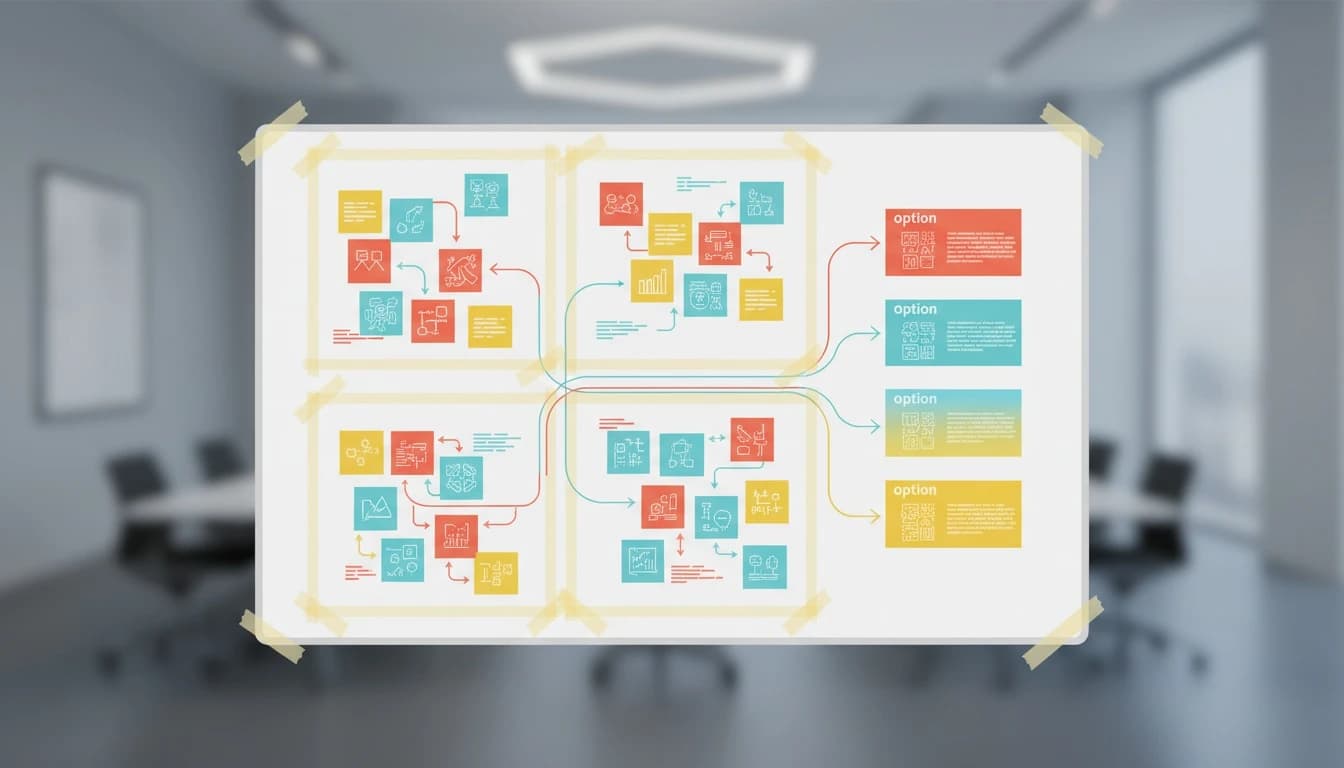
A swot analysis example is only useful if it ends in a decision, not a poster. The fastest way to get there is to run SWOT inside an AI decision board: capture messy notes, translate them into a clean SWOT matrix, then connect each quadrant to options, pros/cons, and second-order consequences so tradeoffs stay consistent as context changes.
What is SWOT analysis and when is it the right tool?
A SWOT analysis is a structured way to separate internal factors (Strengths and Weaknesses) from external factors (Opportunities and Threats) so a team can see what is true about the business versus what is true about the environment. It is not a strategy by itself. It is an input to strategy.
Where SWOT works in the real world: when a product or ops leader has to pick a path and the team is arguing across different “types” of truths. One person is talking about capability (“we can ship fast”), another is talking about market timing (“regulation is changing”), and a third is talking about risk (“support will melt”). SWOT forces those into comparable buckets so you can stop debating language and start debating evidence.
Where SWOT fails: when the decision is already made, when the inputs are guesswork, or when the team needs a decision making matrix more than a diagnosis. If you already have clear options and criteria, skip straight to a matrix. If you do not, SWOT is a strong first pass.
A practical rule I use: SWOT is the right tool when you can answer “What are we deciding?” in one sentence, but you cannot yet answer “What matters most?” without fighting. If you want a broader menu of tools, this breakdown of decision frameworks and when to use each is the mental model I reach for before workshops.
For definitions, keep it grounded: Strengths and Weaknesses are the “describe internal factors of decision making” part (team capability, data, process, cash, brand, distribution). Opportunities and Threats are external (competitors, market trends, regulation, platform shifts). The classic framing is consistent with Wikipedia’s SWOT analysis overview, but the difference between an academic SWOT and an executive-ready SWOT is whether each item can change what you do next week.
How do you write a SWOT analysis from messy notes?
How do you write a SWOT analysis from messy notes? You start by refusing to clean them up too early. Messy notes are valuable because they contain edge cases, fears, and “I saw this once” anecdotes that surface real constraints.
Here’s the workflow that reliably gets teams from chaos to a usable matrix in under an hour.
Step 1: Split notes into internal vs external first
Before you label anything Strength vs Weakness, do the simpler split: internal (you can change it directly) vs external (you can only respond to it). This is where most teams get stuck, so I use one sentence tests:
If you can fix it with hiring, process, budget, or product work in a quarter, it is internal.
If it changes because customers, competitors, platforms, or policy change, it is external.
This prevents the common mistake of calling “competitor is strong” a Weakness. That is a Threat.
Step 2: Rewrite each note as a claim with a timeframe
A good SWOT item reads like a claim you could validate, not a vibe. “Brand is weak” is unusable. “Unaided brand recall in our target segment is under 10%” is usable. If you do not have the number, write the assumption and mark it.
I push teams to add a timeframe because it forces relevance: “Support backlog is rising” becomes “Support backlog has grown 35% in the last 6 weeks and is trending up.”
Step 3: Add evidence, owner, and decision impact
This is the difference between a swot analysis example that looks good and one that drives action. Every item should have:
Evidence (a metric, a customer quote, a competitor move, a source)
An owner (who will validate it or mitigate it)
Decision impact (which options it strengthens or blocks)
This is also where a decision board helps. Instead of freezing the SWOT in a slide, you keep it as living inputs that can be attached to options and updated.
What SWOT analysis example formats work for teams?
What SWOT analysis example formats work for teams? The best format is the one that makes tradeoffs visible and prevents duplicates. In practice, teams need more than a 2x2. They need a 2x2 plus decision metadata.
Below is a format I’ve used with product and ops teams that keeps the SWOT simple but makes it decision-ready.
Quadrant
What belongs here
Example (good)
Common failure mode
Strengths
Internal advantages you can leverage now
“Release cadence is weekly with <2% rollback rate”
“We’re innovative”
Weaknesses
Internal constraints that slow or limit options
“Sales cycle is 74 days for mid-market, hurting cash flow”
“Marketing is bad”
Opportunities
External tailwinds or openings you can exploit
“Competitor raised prices 18% and churn is visible in reviews”
“Market is growing”
Threats
External risks that can hurt you regardless of effort
If you run workshops, add two columns to your template (even if you keep the 2x2 visually): Evidence and Decision impact. This keeps the team from arguing about adjectives.
A concrete swot analysis example (product + ops)
Scenario: A B2B SaaS team deciding whether to (A) launch self-serve, (B) double down on enterprise, or (C) partner with a platform.
Increases urgency for partnerships or differentiation
Notice what is missing: generic statements. Each line points to a lever you can pull or a constraint you have to respect.
If you want to go one step further, you can translate the SWOT into a decision matrix template and score options. That is essentially multiple criteria decision analysis in plain language: criteria, weights, scores, sensitivity checks. (If you need a lightweight alternative, an impact vs effort matrix can be a fast filter, but it is weaker for high-stakes choices because it ignores risk and second-order consequences.)
How do you turn SWOT into a decision-ready options map?
How do you turn SWOT into a decision-ready options map? You treat each SWOT item as an input to options, not as an output. The goal is to end with 2-4 options you can compare side-by-side, each with pros/cons, consequences, assumptions, and next steps.
This is where Lucid’s approach matters: a board view that updates as context changes. In real teams, the SWOT changes weekly. A competitor ships. A metric shifts. A regulation gets delayed. If your SWOT is a static slide, your decision logic becomes stale.
The conversion method I use (SWOT - Options - Criteria - Risks)
Draft options first, not last. Even rough options are fine: “Self-serve launch in 8 weeks”, “Enterprise-only with 2 new compliance features”, “Platform partnership with revenue share”. Options are the spine of the board.
Attach SWOT items to options as supporters or blockers. Strengths and Opportunities typically support certain options. Weaknesses and Threats typically block or add risk. This instantly reveals which options are fantasy.
Turn attachments into criteria. If a SWOT item matters, it becomes a criterion. Example: “Implementation requires 6 hours” becomes a criterion like “Time-to-value under 30 minutes without human help.” Now you can score options in a decision matrix example that is traceable back to evidence.
Add assumptions and scenario analysis. Any Opportunity or Threat that hinges on uncertainty needs a scenario. Example: “Compliance requirement adds 3 controls” becomes scenarios: on-time, delayed 6 months, expanded scope. This is basic scenario analysis, but it prevents teams from overweighting the loudest fear.
Define mitigations and next steps per option. Weaknesses and Threats are only useful if they produce a mitigation plan. If you cannot write a mitigation, you either need a different option or you are not ready to decide.
A decision-ready board should let you switch views depending on what the team needs: a grid for scanning, a table for scoring, and a focus view for deep work. If you prefer to formalize the flow, you can even sketch a quick decision flowchart: “If compliance lands in Q3, choose B; if delayed, evaluate A vs C.” It sounds simple, but it saves weeks of circular debate.
A simple options map table (what “decision-ready” looks like)
Option
SWOT-backed advantages
SWOT-backed risks
First mitigation to test this week
A: Self-serve
Leverages strong onboarding completion and rising category interest
Implementation time blocks scale
Prototype guided automation for top 3 setup steps
B: Enterprise
Fits current solutions-heavy delivery
Suite bundling threatens differentiation
Package compliance features as a distinct wedge
C: Partner
Uses external distribution to offset brand weakness
Revenue share and roadmap dependency
Validate partner pipeline and integration scope
This is the moment the SWOT stops being a brainstorm and becomes a system. The board stays coherent because each pro/con is tied to a specific SWOT input, and each input has evidence and an owner.
If you want a repeatable cadence, I recommend a monthly SWOT refresh and a weekly options review. We run this with teams that tend to overthink: the structure reduces anxiety because nothing gets “lost”, and the decision logic stays visible.
Frequently Asked Questions
What are the 5 pros and 5 cons of AI?
Pros: speed, pattern detection, consistency, scalability, and decision support when data is messy. Cons: hallucinations, bias amplification, overconfidence from polished output, privacy risk, and weak accountability if humans do not own the call.
What are the pros and cons of AI for decision-making?
AI is great at structuring inputs, generating options, and stress-testing consequences across scenarios. It is bad at value judgments, hidden incentives, and organizational politics, so you still need explicit criteria and a clear decision owner.
What are the benefits of using a Reliance Matrix?
A reliance matrix clarifies dependencies between teams, systems, or workstreams so you can see where one choice creates bottlenecks. It pairs well with SWOT when Threats or Weaknesses are really dependency risks (like platform reliance or vendor lock-in).
How do you calculate the MAP?
MAP usually refers to Mean Average Precision in information retrieval, which is not part of SWOT. If you are evaluating AI search or recommendation quality as part of a SWOT Threat or Opportunity, MAP can be a useful metric, but it belongs in your evidence column, not the matrix itself.
Turn your SWOT into a decision you can defend
Start by writing your decision in one sentence and dumping your raw notes into four buckets: internal vs external, then Strength/Weakness and Opportunity/Threat. Next, convert each item into a claim with evidence and attach it to 2-4 real options.
If you want the fastest path from “messy” to “decision-ready”, build the SWOT inside an options board so your pros/cons and consequences update as the context changes. Create your first board in Lucid and pressure-test one decision this week: create a Lucid account to map options side-by-side.