Decision-making bias is the predictable way smart people make distorted business choices when pressure, incomplete data, and strong opinions collide. This complete guide breaks down the cognitive bias patterns that most often derail teams, how they show up in real decisions, and the debiasing techniques I’ve used to get to cleaner tradeoffs and faster alignment.
What decision-making bias looks like in real business decisions
Decision-making bias is any systematic deviation from rational judgment that pushes you toward the wrong option for reasons unrelated to the actual evidence. Wikipedia’s overview of cognitive bias is a solid starting point, but the practical reality is messier: bias usually doesn’t look like “bad logic.” It looks like speed, confidence, and a story that feels coherent.
Here are a few patterns I’ve seen repeatedly in product and operations rooms:
A leadership team “decides” to expand into an enterprise segment, but the decision was effectively made the moment the first big inbound lead appeared. Every subsequent meeting becomes evidence collection to justify a foregone conclusion.
A hiring panel compares every candidate to the first interview of the day (anchoring), then rationalizes the ranking with post-hoc criteria like “culture fit” that were never defined upfront.
A team keeps funding a feature because “we already put two quarters into it,” even when the data says it’s cannibalizing activation (sunk cost).
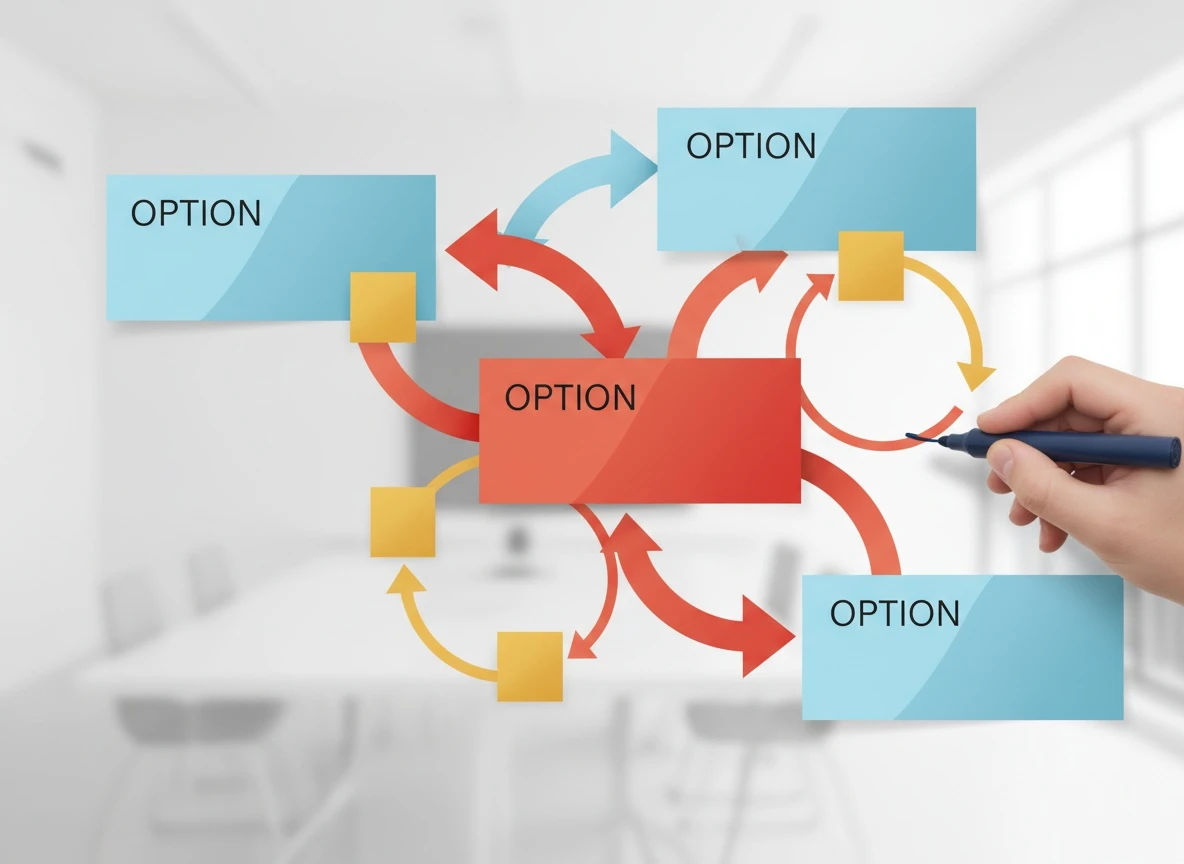
Bias thrives when decisions are unstructured. The fix is not more debate. The fix is a better decision logic container: clear options, explicit criteria, and a way to surface consequences before you commit.
Cognitive bias is a huge universe. In business, you don’t need a taxonomy. You need to know which biases create the biggest downstream cost: wasted spend, slow execution, and decisions you can’t reverse.
The table below is the shortlist I use because each one hits common “high-stakes, low-clarity” moments: pricing, hiring, roadmap, vendor selection, strategy shifts.
Bias
What it does to your decision
High-stakes example
Fast counter-move
Confirmation bias
Filters evidence to protect the preferred option
Only interviewing customers who already like the concept
Require disconfirming evidence before approval
Anchoring
Overweights the first number or idea heard
First vendor quote sets the “reasonable” budget
Collect independent estimates before discussion
Availability bias
Overweights vivid recent examples
One churned customer dictates the roadmap
Use base rates and cohort data, not anecdotes
Overconfidence
Underestimates risk and uncertainty
“We’ll ship in 6 weeks” with no buffer
Use ranges and pre-mortems, not single dates
Sunk cost fallacy
Keeps you invested in losing paths
Continuing a replatform because “we started”
Set kill criteria in advance and honor them
If you want a structured way to choose the right approach for your context (team size, stakes, reversibility), use how to choose a decision framework for your team as a companion. Framework selection is a surprisingly effective debiasing step because it stops you from improvising under stress.
Confirmation bias: the silent killer of strategy
Confirmation bias is the tendency to seek, interpret, and remember information that supports what you already believe. The reason it’s so destructive is that it masquerades as diligence. You can do a lot of “research” and still be bias-driven.
The first sentence I look for in a doc is a tell: “We believe X, and we’re looking for validation.” That’s not discovery. That’s prosecution.
How confirmation bias shows up
It shows up as selective sampling (talking to friendly customers), selective metrics (choosing a success metric that the favored option already wins), and selective skepticism (scrutinizing disconfirming data harder than confirming data).
Harvard Business Review has covered how leaders can reduce distortions by building disciplined decision routines; their broader decision-making research is worth browsing, starting with Harvard Business Review’s decision making collection.
Debiasing techniques that work in practice
The best debiasing technique I know for confirmation bias is forcing a “disconfirming evidence” gate. Before a decision moves forward, someone must present the strongest case against it, backed by real data. Not vibes. Not hypotheticals.
I also like a simple split: discovery work must include at least one source that would be uncomfortable if true. For example, if you’re considering a price increase, your research plan should include churn risk analysis by segment and interviews with customers most likely to leave, not only your champions.
If you’re using a structured board to lay out options and consequences, you can make “evidence for” and “evidence against” explicit columns. That’s the kind of structure Lucid is built for: turning messy inputs into a comparable options map so bias is visible, not implicit. If you want the broader foundations first, Decision Frameworks: The Complete Guide pairs well with this.
Anchoring and how to stop the first number from winning
Anchoring is when an initial value or idea disproportionately influences your final judgment, even if it’s arbitrary. In negotiations it’s obvious. In internal planning it’s sneakier.
A classic example: the first forecast in a planning cycle becomes the reference point. Every update is a small adjustment around it, even when reality changes.
Anchoring is why teams miss budgets, timelines, and headcount needs in a consistent direction. They don’t “lie.” They anchor early, then rationalize.
A simple anti-anchoring protocol (that teams actually follow)
This is one place where order matters, so I’ll be explicit:
Collect independent estimates first (budget, timeline, effort, impact) in writing before any discussion.
Share the range, not the average, and ask what would have to be true for the low and high ends.
Only then discuss a target number, and record the assumptions that justify it.
This is also where a decision flowchart can help. If your process forces independent inputs before group convergence, you reduce social anchoring and groupthink at the same time.
Decision-making bias in groups: consensus vs unilateral choices
Decision-making bias gets worse in groups because people are managing status, fear, and politics while trying to reason. The bias isn’t only cognitive. It’s social.
Consensus decision making can reduce blind spots when the team has diverse information, but it can also create watered-down compromises where nobody owns the outcome. Unilateral decision making can be fast and coherent, but it increases the risk of one person’s biases becoming the company’s reality.
The fix is not picking one forever. It’s matching the decision mode to the decision type.
Here’s the rule I’ve used: if the decision is reversible and low-cost, let a single accountable owner decide quickly with lightweight input. If it’s irreversible or high-cost, use a structured group process that forces explicit tradeoffs and consequences.
A practical way to do that is to standardize the decision making process with a visible artifact: options, criteria, risks, and second-order effects. When teams can compare paths side-by-side, the conversation shifts from persuasion to evaluation.
If you want a tool-based workflow, Lucid’s decision board format is designed for exactly this: capture free-form context, generate an options map, and compare in Grid, Table, or Focus views as the context changes. Start with a real dilemma, not a hypothetical, and you’ll feel the difference in the first 10 minutes.
Debiasing techniques you can operationalize this week
Debiasing techniques fail when they’re abstract. “Be aware of your biases” is not a technique. It’s a poster.
Operational debiasing is about building constraints into how decisions get made. The goal is not perfect rationality. The goal is fewer unforced errors.
Use a decision making matrix when stakes are real
A decision making matrix is a structured way to score options against criteria. It’s not magic, and it’s easy to game, but it forces clarity on what you’re optimizing for.
A lightweight decision matrix template I like uses 5 criteria max and a forced weighting so teams can’t pretend everything matters equally. If you’re looking for an end-to-end approach, Decision Frameworks: The Complete Guide covers when matrices work and when they backfire.
Run a pre-mortem to expose hidden risks
A pre-mortem is when you assume the decision failed and work backward to explain why. Psychologist Gary Klein popularized it, and it’s one of the few “workshop” techniques that consistently produces useful risk identification.
One clean way to run it: “It’s six months from now. This decision was a mistake. What happened?” Then capture causes as testable assumptions. Assumptions are where bias hides.
Set kill criteria before you start
Sunk cost is only powerful when you haven’t agreed on what would make you stop. For investments like replatforms, new segments, or AI initiatives, define kill criteria upfront: thresholds that trigger a pause or shutdown.
This is also how you keep “investment into AI” rational. AI programs drift when they’re justified by excitement instead of measurable outcomes. If you’re building internal AI capability, Google Cloud AI team setup and usage is a useful reference for what real adoption looks like beyond pilots.
One sentence that prevents most bias-driven meetings
Write this at the top of the doc: “What would change our mind?” If the team can’t answer it, you’re not making a decision. You’re defending a preference.
How to use system analysis to catch bias before it ships
System analysis is the discipline of looking at a decision as part of a larger system: inputs, constraints, feedback loops, downstream consequences, and failure modes. When you do system analysis well, bias becomes easier to detect because you’re forced to model reality instead of arguing narratives.
The most practical version is a consequence map. For each option, you write the first-order impact and the likely second-order effects. Second-order thinking is where most teams get burned: sales incentives distort product priorities, pricing changes shift support load, hiring plans change management bandwidth.
Here’s a compact table format that works well in exec reviews:
Option
First-order win
Second-order consequence
What to monitor
Raise price 15%
Higher ARPA this quarter
Increased churn in price-sensitive segment
Churn by cohort, downgrade rate
Add enterprise features
Larger deal size
Longer sales cycles, more custom work
Cycle time, services load
Cut low-usage features
Lower maintenance cost
Risk of alienating power users
NPS by segment, retention
When you build decisions this way, you’re doing system analysis without turning it into an academic exercise. You’re giving the team a shared model of reality that can be updated as new data arrives.
Lucid’s approach aligns with this: you can start with messy notes or a recorded brain dump, generate a structured options board with pros, cons, and future consequences, then update the board as assumptions change without losing consistency. If you want to try it, create a Lucid account and run your next real decision through a board instead of a doc.
Frequently Asked Questions
What are the pros and cons of AI for decision making?
AI can surface options, summarize evidence, and reduce manual analysis time, which helps counter availability bias and narrow framing. The downside is automation bias: teams may over-trust outputs, especially when the model sounds confident but lacks grounding in your context.
What are the 5 pros and 5 cons of AI?
Pros: speed, pattern detection, scenario generation, consistency, and scalability. Cons: hallucinations, hidden bias in training data, privacy risks, overreliance, and unclear accountability when recommendations drive outcomes.
Which cognitive biases should leaders focus on first?
Start with confirmation bias and anchoring because they distort both strategy and execution planning. Then address overconfidence and sunk cost, since they create repeated delivery misses and prolonged investments in failing paths.
How do I reduce decision bias in a team meeting?
Collect independent inputs before discussion, define decision criteria upfront, and require disconfirming evidence for the preferred option. A visible decision matrix or options board keeps the conversation anchored to tradeoffs instead of persuasion.
Your next step: pick one decision you’re currently overthinking and run it through a structured options map. Write the options, list the assumptions you’re relying on, and add one second-order consequence per option. If you want a faster workflow, capture the dilemma in Lucid and compare the paths in Grid or Table view until the tradeoffs are undeniable.