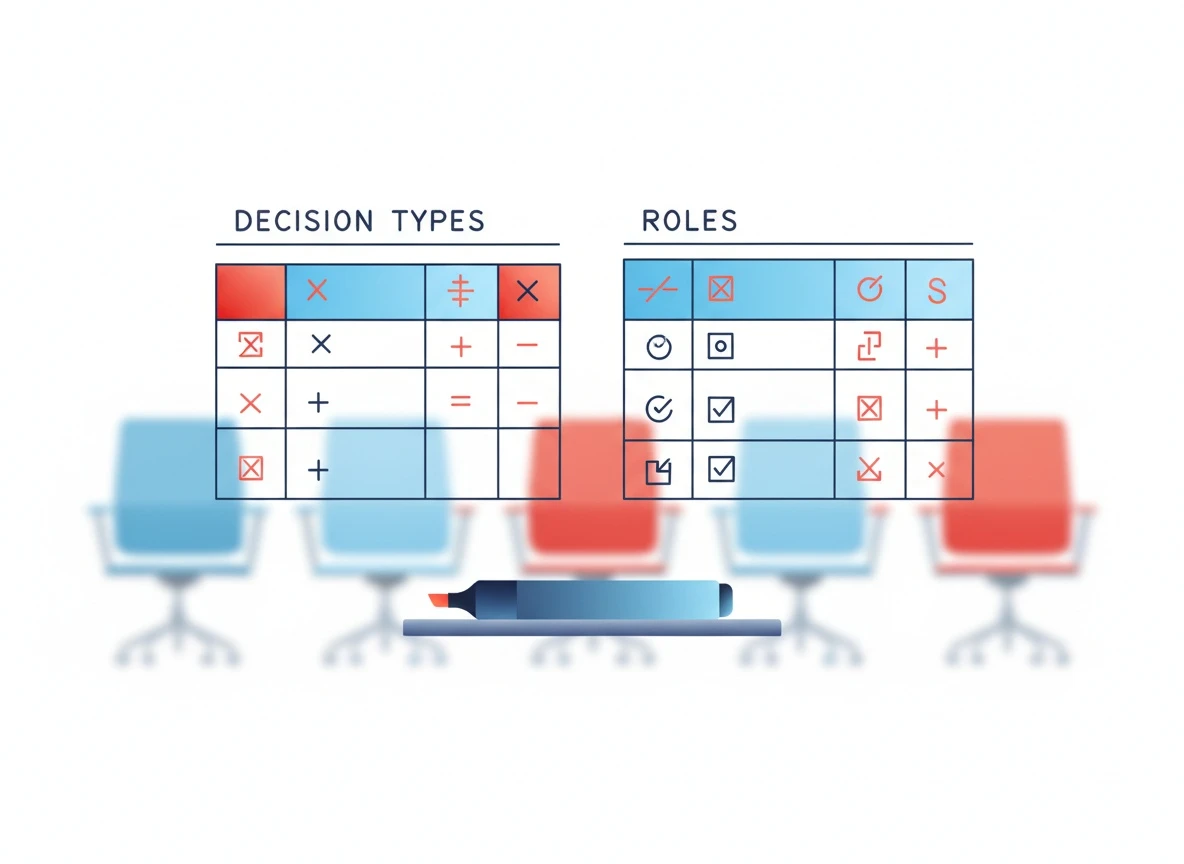
System analysis is the fastest way I know to stop governance from turning into Slack arguments and stalled launches. If you are choosing between an approval matrix and a RACI chart, the rule is simple: approval matrices clarify who can say yes at each decision point, while RACI clarifies who does the work and who is accountable. This guide gives you a practical pick-the-right-tool playbook, with examples you can reuse.
Approval matrix vs RACI: the 30-second difference that matters
Approval matrix vs RACI is not a formatting preference. It is a governance choice.
An approval matrix (often called an approval matrix template in ops teams) is a structured grid that maps decision types to who must approve (and sometimes who must be consulted or informed). It is built for control, compliance, and speed at the moment of commitment.
A RACI chart is a responsibility assignment matrix that maps tasks or deliverables to roles: Responsible, Accountable, Consulted, Informed. It is built for execution clarity and preventing “I thought you had it” failures.
If your pain is “we do not know who can approve this,” you want an approval matrix. If your pain is “we do not know who owns this,” you want RACI.
Approval matrix is the tool you reach for when the organization needs a consistent, repeatable answer to “Who has the authority to approve this?”
You see it in finance approvals, vendor onboarding, security exceptions, hiring bands, pricing changes, legal review, and launch readiness gates. It is also the backbone of many “workflow approvals” systems because it translates cleanly into rules.
In practice, the approval matrix wins when:
The decision is reversible only at high cost (security incident, legal exposure, brand risk).
You need auditability and traceability (who approved, when, under which policy).
Approvals must scale beyond personal relationships (new managers, new regions, M&A).
A useful mental model is decision logic: approval matrices encode decision logic in a way that can be enforced. RACI cannot do that on its own because it is not built around decision thresholds.
If you want the formal definition of “accountability” and governance structures, the RACI matrix overview on Wikipedia is a decent baseline, but most teams fail because they stop at definitions instead of designing for real workflow friction.
What a RACI chart is (and when it wins)
RACI is best when the work itself is the messy part: multiple functions, parallel streams, ambiguous ownership, and handoffs that break under pressure.
RACI wins when:
You have cross-functional delivery (product, design, engineering, marketing, legal).
You are seeing duplication (“two teams built the same thing”) or gaps (“nobody did the enablement deck”).
Your bottleneck is coordination, not authority.
The most common RACI failure mode I see is over-assigning “A.” If more than one role is Accountable for a deliverable, you have created a committee. Committees do not ship.
A good RACI is short, tied to real deliverables, and reviewed at the start of a project and again at the first major scope change. If you need a broader menu of frameworks beyond RACI, Decision Frameworks: the complete guide is a helpful reference.
Decision rights vs responsibilities: a practical system analysis test
System analysis, applied to governance, is basically: identify where the system breaks, then choose the artifact that fixes that failure.
Here is the test I use with teams. Look at your last 10 delayed decisions and categorize the delay:
Delay symptom
Root cause
Use this tool
“We do not know who can approve this.”
Missing decision rights
Approval matrix
“We know who approves, but nobody prepared the info.”
Missing ownership of inputs
RACI (and maybe a decision flowchart)
“The approver is clear, but it takes weeks.”
Too many gates or unclear thresholds
Approval matrix redesign + tighter thresholds
“Work is happening, but nobody is accountable for the outcome.”
Accountability confusion
RACI
“We keep re-litigating the same tradeoffs.”
No structured comparison
Decision making matrix + scenario analysis
That last row is where tools like Lucid help. When teams are stuck in the valley of decision (plenty of opinions, no closure), a structured options board forces the tradeoffs into the open and keeps consequences consistent as context changes.
Side-by-side comparison: approval matrix vs RACI chart
This is the simplest matrix comparison that actually holds up in real operations reviews.
If you are building a decision matrix example for leadership, this table is usually enough to settle the debate quickly.
Two worked examples (so you can copy the pattern)
Example 1: Vendor onboarding (approval matrix wins)
When a team wants to onboard a new vendor, the decision is not “do the work,” it is “are we willing to accept the risk and cost.” You typically need thresholds: spend level, data access level, contract terms.
A clean approval matrix for vendor onboarding uses rows like “SaaS with customer data access” and columns like “Security,” “Legal,” “Finance,” “Business owner.” The rule set becomes enforceable. That is why approval matrices often end up implemented in ticketing systems.
To keep it fast, define what “approval” means. For example: Security approves only data handling and access scope, not pricing. Legal approves terms, not architecture. This sounds obvious, but it is where approvals sprawl.
Example 2: Product launch (RACI wins, approval matrix as a thin layer)
For a launch, the work is multi-threaded: messaging, pricing, docs, analytics, support readiness, rollout plan. RACI is the right backbone because it prevents invisible gaps.
Then add a thin approval matrix only for the high-stakes gates: “Launch to 100% traffic” might require approval from Product, Engineering, Support, and Security. “Copy changes” probably do not.
If you want a repeatable way to pick those gates, treat it as scenario analysis: what is the cost of being wrong, and how reversible is it?
The biggest governance problems are not tool problems. They are design problems.
First, too many approvers. Every additional required approver increases cycle time and creates a coordination tax. If you need evidence, the queueing theory dynamics are the same ones that make multi-stage processes slow. When approvals balloon, reduce them by tightening thresholds and making “consulted” explicit rather than implicit.
Second, RACI that turns into a phonebook. If your RACI has 40 rows and 18 roles, nobody uses it. Tie it to the 10 to 15 deliverables that actually move the project. Everything else can live in a task tracker.
Third, no explicit decision point. Teams drift because they never define when a decision is made. A lightweight decision flowchart can help: draft, review, approve, implement, validate. Even better, define “decision ready” criteria (data, options, risks) so approvers stop being asked to approve vague intent.
Google’s own guidance on reducing friction in processes is usually framed around clarity and accountability in operational systems. Their Google re:Work content on decision making is worth scanning for practical management patterns that reduce coordination overhead.
How Lucid helps when you need both: approvals plus clear tradeoffs
Approval matrices and RACI charts tell you who. They do not force clarity on what you are choosing between.
When a decision is contentious, teams need a structured options map: real alternatives, pros and cons, and second-order consequences. That is where Lucid fits. You can write or record a messy dilemma, generate an options board, then compare paths in Grid, Table, or Focus view. When new context arrives, the board updates without breaking the logic.
If you are standardizing governance across a team, start with the frameworks and then operationalize them. We cover the selection layer in Decision Frameworks: the complete guide, then use Lucid to keep the decision record coherent as reality changes.
Frequently Asked Questions
What is the benefit of using an approval matrix?
An approval matrix makes decision rights explicit, which reduces back-and-forth and prevents shadow approvals. It also creates an auditable trail for spend, risk, and policy decisions.
Can you use RACI and an approval matrix together?
Yes, and strong teams often do. Use RACI for delivery ownership, then apply an approval matrix only to the small set of high-risk gates where authority and compliance matter.
What is the difference between a decision making matrix and an approval matrix?
A decision making matrix compares options against criteria to pick the best path. An approval matrix defines who must sign off once a path is chosen.
Why do RACI charts fail in practice?
They fail when “Accountable” is assigned to multiple roles, or when the chart is too detailed to be usable. Keep it tied to real deliverables and enforce single-threaded accountability.
Ready to fix stalled approvals this week? Pull up one recent decision that took too long, write down the exact decision point, then choose the artifact that matches the failure: approval matrix for decision rights, RACI for ownership. If the tradeoffs are still muddy, capture the dilemma in Lucid and turn it into a board you can compare side by side, then share it for clean approval. Start with a fresh board at create a Lucid account.